Showing posts with label Review. Show all posts

Sunday, January 22, 2012

Blogging Sacrilege, chapter 6: How to Win

(Source)
I don't have to be an oppressive, insecure, offensive fundie to be a Christian. There's a way to follow God in the way of Jesus and win the world with the original message of Good News.
I hope to show that this is why Jesus calls us to meekness in this Beatitude: "Blessed are the meek, for they will inherit the earth" (Matt. 5:5)
Jesus the humble and meek, who climbed down out of heaven to come and build a home in our neighborhood, is the answer for both the conflict in the Middle East and the wars fighting within every human heart. Jesus wants his people, his apprentices, to win--to see people changed and converted to his ways--but the methods of winning are just as important as the win itself, because they can't be separated. We win with meekness.
(Hugh Halter, Sacrilege)
A month or so ago I finished Anathea Portier-Young's Apocalypse Against Empire. As part of a larger project contextualizing Jewish apocalyptic writing, Portier-Young provides an approachable yet deeply insightful and precise analysis of life in Jerusalem under imperial Seleucid rule during the years preceding the Maccabean rebellion. I turned over the last page of the volume with a list authors to chase down and my understanding of the literary and cultural context into which Jesus stepped some a century or more later radically redefined.

The fifth chapter of Apocalypse Against Empire, "Seleucid State Terror,"did much of the heavy-lifting in reshaping my understanding of Jesus' context. Portier-Young systematically reviews the archaeological evidence for and the cultural meaning of state sponsored massacres, murders in the home, abductions (for the slave market), and plundering of the temple. Against the backdrop of subjugated Jewish identity Portier-Young establishes in chapter 3, "Interaction and Identity in Seleucid Judea: 188-173 BCE,"this litany of state-sponsored violence (physical and otherwise) begins to help me understand the way in which Jesus' contemporaries--under the oppressive rule of another empire--may have understood themselves, their history, and their oppressors.

Enter Jesus. Jesus proclaiming good news from God about a new kingdom arriving. Jesus disrupting social structures that separated the honorable working poor from beggars, bandits, and those who survived outside the official market in goods and services. In healing the sick, purifying the unclean, exorcising the demonized, Jesus brought the outcasts back into the company of good and honest society.

Without a doubt, Jesus sparked hopes that God was finally going to intervene and set up a utopian society, one in which God truly dwelled in Zion and all the (oppressing) nations came and brought tribute to Jerusalem. (We have no doubt about this because John's Gospel confirms in 6.15).

The first few lines of Jesus' kick-off sermon initially seem to confirm this: "Blessed are the poor"--"Amen!" the people thought, "it's time the good and godly poor were visited by God's blessed intervention on their behalf. Maybe this new kingdom will involve less imperial taxation."  Jesus continues, "Blessed are those who mourn, for they will be comforted." And again the people think, "Amen! We've mourned the ruin of David's kingdom for nearly six hundred years. Now Herod presumptuously builds another stand-in temple for us, but what we long for is God to return and set up God's own temple. God, do, come and comfort your people!"

But just as Jesus' followers reach for the pitchforks and scythes to follow their new leader to the seat of power up in Jerusaelm, Jesus says, "Blessed are the meek, for they will inherit the earth."

Sunday, January 15, 2012

Blogging Sacrilege, chapter 5: Comfort, comfort ye my people!

Hugh Halter titles chapter 5 of Sacrilege "The Problem with Family Values." This, IMHO, is a sign of hope.

I am a member of the generation who grew up with "family values" broadcast every morning from Focus on the Family on AM Christian radio. I read the books that, under the guise of defending "absolutes," really duked it out for traditional "family values" (cf. Josh McDowell's Right from Wrong). It seemed then that the fate of Christianity, or American Christianity, stood or fell with the family seated around the table for dinner, teens' attitudes about cheating, and kids keeping their pants on until they were married. The battle over "family values" was in the cultural air so much that Korn would launch the tongue-in-cheek Family Values Tour in Summer 1998.

In his reflection on the second Beatitude, Halter calls "family first" habits and values into question in favor of a practice of hospitality. I fully support this cause. He writes,
"So what I'm suggesting is this: cut out some of the nonstop activities and make room for a few more people in your family room. Keep margin in your life, blank days on your calender, and flexibility in your spare time so that you can adopt a few 'orphans' into your life."
Right on, Hugh! Opening our lives (which some would say is one of the first motions of love) requires that we topple the idols, dethrone the powers which enslave us. Sometimes this is our devotion to our families, our homes, or, even, our hobbies.

Monday, January 9, 2012

Blogging Sacrilege, chapter 4: Letter to a Greek Professor

[Source]
After I'd graduated from college with my degree in Bible and smattering of biblical Greek and Hebrew, I remember sitting down and typing out an email to a former prof asking about Jesus inauguratory teaching in Matthew 5: makavroi oiJ ptwcoi; tw/: pneuvmati, o”ti aujtw:n ejstin hJ basileiva tw:n oujranw:n.


For the words that Matthew chooses to introduce Jesus' first meditation on what his good news means for the community he's called around him, these are strange words. Up to this point, in Matthew's telling, Jesus' only public words have been "Repent! For the kingdom of heaven is arriving!" and "Come along with me, and I'll make you fishers for people." So now, after a healing or two, Jesus finally sits down to instruct his followers in what this is all about. And what does he say? "Blessed are the poor in spirit, because the kingdom of heaven is theirs."

Who are these people who have it good? That's what I wanted to know from my Greek professor. What does poverty, spiritual or otherwise, have to do with the dunked-in-the-cleansing-blood gospel I'd confessed from childhood onward? I'm still waiting for an answer that makes complete sense of this to me.

Surprisingly enough, Hugh Halter takes on this saying of Jesus in chapter 4 of Sacrilege. In fact, the remaining chapters of the book seem to take the Beatitudes one-by-one for a structure. Not something I expected from the billing on the book's cover. but I'm always open, even excited, to return to Jesus' words and wait and listen.

Friday, January 6, 2012

Blogging Sacrilege, chapter 3: Enough Said

Mike shared this lesson: "You see, Hugh, in a courtroom, people see things based on preconceived beliefs. We think people simply believe what they see, but in reality, people see what they already believe. Thus a good attorney must learn to tell the story in a way that helps people see things differently."
(Hugh Halter, Sacrilege)
Enough said.

Thursday, January 5, 2012

Blogging Sacrilege, chapter 2: The Nitty-Gritty and Important

At one time Christ followers lived every moment in the teachings and style of their leader. But somewhere along the way these adventurers turned into adherents of doctrine. People of faith became risk-averse. Kingdom revolutionaries succumbed to the world's kingdoms. Counterculture architects became wards of the state, sellouts, and seeker-sensitive consumers.
(Hugh Halter, Sacrilege)
It's time to get down to the nitty-gritty. I find myself nodding in time with many of the statements in chapter 2 of Sacrilege. I agree, the gathering of imitators of Christ has over the last two thousand years become a convention of aficionados. But my question--which I believe is an important questions--is about the specifics and the details of this change. From what have changed? Into what are we changing? What elements in this change are appropriate to the evolution of culture, politics, means of production, etc.? What elements are not appropriate to the Pioneer of our faith?

Wednesday, January 4, 2012

Blogging Sacrilege, chapter 1: Jesus and Joe the Plumber


Do you remember Joe the Plumber? Picture yourself back in the 2008 US presidential campaigns. Some guy from Ohio happens into a conversation with Obama, and briefly thereafter he’s the media flavor of the minute. One day he’s a small business owner in Holland, Ohio; the next, he’s the symbol of everyman, symbol of the common folk who are going to help this country get back on its feet. He’s the mascot of Candidate X’s ambitions for office.
Jesus often gets the same treatment.

Twice in chapter 1 of Hugh Halter’s Sacrilege Jesus shows up in a subtitle. First we meet “Jesus the Iconoclast.” It’s Jesus who fights and overcomes the hold of popular piety, of social taboos, of skin-deep legalism and false shows of godliness. Hugh writes, “Jesus went against almost every religious norm and won the hearts of the heathen. His ability to de-sacredize the sacred (when doing so was important to the purpose of God) magnetized people to him, and his followers were expected and empowered to do the same.”
As Hugh explains, iconoclast means image or idol breaker. I agree that Jesus disrupts all our pictures of the way things should work, all our self-serving imaginations of God and life and love and why.
But I wonder if introducing Jesus first as iconoclast, a de-sacredizer strays from the stories we’ve heard. See, the Bible, especially the Hebrew Bible is full of iconoclasts. Israel had plenty of idol-smashers, from Moses when he comes down from Sinai to find a golden calf replacing the imageless Yahweh to Gideon chopping down the Asherah pole by night to the words of latter prophets filling the back third of our Hebrew Bibles. But Jesus, even with all this material to draw on, doesn’t style himself an idol-smasher.

Tuesday, January 3, 2012

Blogging Hugh Halter's Sacrilege, part 1, Introduction

Sacrilege by Hugh Halter
Mike Morrell turned me on to Hugh Halter's Sacrilege through the guerilla blog book reviews he facilitates. And, while I've never tried this sort of thing with any success in the past, I've purposed to blog my way through the book.

So here goes.

I've had a little previous contact with Hugh. By a little, I mean I once read most of Hugh and Matt Smay's earlier Tangible Kingdom with a friend and mentor in church-planting. I recall liking most of what I read there, though I can remember exactly what I liked about the book. When Sacrilege came up for review, it was less Hugh's name on the cover than the Shapevine series that it is part of that attracted me to it.

Onward to the Introduction.

Hugh begins with stories, two of them. He recounts a trip to Beirut, Bethlehem, and Jerusalem, and retells his own process of find and re-finding the "real Jesus."

Saturday, May 21, 2011

Review :: Revise Us Again :: Frank Viola

This afternoon I joined many others from my church-community to help a friend move to a new apartment. After we had carted the last box, last couch, last bookshelf up two flights of stairs and milled about for some celebratory Little Caesar’s Hot-N-Ready’s to arrive, a teen let out an exclamation of delight and beckoned me over to the bathroom window. 

“Look down, you can see the neighbor’s koi.”
I looked down, and from our birds-eye perspective, we could see a beautiful fish pond and porch the neighbors had constructed behind their three flat. We stood, leaning over the bathtub, elbows on the bathroom window sill, watching their orange and gold and white bodies oscillate slowly in the water.
I’ve seen koi before. I’m usually not a big fan. I think of them like I think of goldfish--carp in a cage, bred to be pretty but vulnerable in the bigger fish-eat-fish ocean. But from this perspective, gazing down from thirty feet up, with the Chicago rain falling out of a hard grey sky, these fish were beautiful. A hint of nature among the bricks and concrete.
I enjoyed parts of Frank Viola’s Revise Us Again: Living from a Renewed Christian Script. I also was annoyed with parts. The book has its up and downs. 
I don’t want to focus on Revise Us Again as a whole. Initially because it feels a bit too scattered to draw out a single guiding thesis (though the theme--or is it a conceit--of revising the scripts we are practiced in in practicing our faith does run constant and true throughout form beginning to end). But more pressingly, I don’t want to give my page by page response to Viola’s book because all my attention is caught by Viola’s Afterword appended to the body of the text.

Monday, May 9, 2011

Review :: The Power of Religion in the Public Sphere :: Judith Butler, Jürgen Habermas, Charles Taylor, & Cornel West, et. al.

Englewood Review of Books just published my review of The Power of Religion in the Public Sphere by Judith Butler, Jürgen Habermas, Charles Taylor, & Cornel West.

I'll post here the first few paragraphs of the review, but to hear my full take on this interesting volume, you'll have to head over to ERB.

When I hear a sermon or a lecture, I often wonder what sort of script the speaker is using. Not just prepared remarks propped on the lectern or stored in the memory. I’m curious about the cultural scripts that shape and guide what she has to say, the tacitly assumed goals, strategies, evaluative criteria of public discourse.
The Power of Religion in the Public Sphere is less scripted than most essays collections in ethics or political philosophy. That’s because The Power of Religion isn’t an essay collection. It’s a conversation, minimally edited by Eduardo Mendieta and Jonathan VanAntwerpen, between Judith Butler, Jürgen Habermas, Charles Taylor, and Cornel West. And conversation occasionally careens outside the parameters of the lecture hall.
The October 22, 2009, event this volume recapitulates sought to carry forward dialogue about religion, secularism, and the way we talk about the common good. Fittingly, the event was less four renowned public intellectuals reading four papers and more three discussions between the participants.
Language, deliberation, and translation are key themes that run throughout the four essays and all three discussions. The public sphere is the realm of public conversation about the common good. But a second, unnamed theme runs alongside this consistent concern with language: a concern with power. . . .
For more, head over to ERB. Check out the rest of the issue for other reviews of some good books.

Saturday, March 26, 2011

Review :: The Road :: Cormac McCarthy

Last night I felt the last snow of this Chicago winter. This has been a winter for snow--deep snow, wet snow, thunder snow. Today the sun is shining; you couldn't tell that the sky was spitting snow last night.

I was driving home from work when the Blizzard of 2011 hit Chicago. As I drove toward the lake on Howard Street, the snow hit like a wall. Newscasts forewarned catastrophe. Once I'd found parking, I marched toward my apartment head-down to keep the snow out of my eyes. Drifts were already filling the courtyard of my building. My wife and I took shelter in our apartment reading Laura Ingalls Wilder's The Long Winter while the wind shook our windows and the sky flashed lightning.

All told, Chicago received 20.9 inches of snowfall. Chicago Public Schools canceled school for the first time in twelve years, and then did so for a second day while giant snow eaters cleared roads. I spent forty-five minutes digging out my car (which was buried up to the windows), twice.

I had finished Cormac McCarthy's The Road a few weeks earlier. Apocalyptic scenarios were on my mind. And then there I was, in the middle of the biggest snowstorm to hit Chicago since 1967. The city shut down. Maybe this was a glimpse of the end.

But I think not. In fact, I think this is a backward way of thinking. See, the next day, when the sky cleared to let the bitter cold sunlight illumine the shining city, Cindy and I went for a walk. We pulled on snow boots and muffled ourselves in scarves, and we struck out to cut a trail toward (of course) Dunkin Donuts. What I saw were traces of sled tracks, a recent immigrant family from Africa digging out their minivan, a tired buy behind the counter pouring coffee, parents exploring the snowscape with their toddlers. This wasn't the apocalypse. That came later.

Thursday, December 30, 2010

Review :: Englewood Review of Books' Quarterly Print Edition, Vol. 01, Num. 01


In my family, Christmas extends all the way to Epiphany. My wife and I open our gifts to one another on January 6, remembering the gifts the astrologers brought Jesus in Bethlehem. So, Mom and Dad (if you do in fact read this blog), it’s not too late to slip a subscription to Englewood Review of Books’ Quarterly Print Edition in the mail (hint hint).

Joking aside, I highly recommend ERB’s new Quarterly Print Edition, whether as a Christmas gift or as a worthwhile addition to your own reading list.

A wise professor once told me that the first step in writing a good book review is to “read, read, read lots of reviews.” I took his words to heart. I began reading nearly every book review I could lay my hands on--Commonweal, The New York Review of Books, reviews in various academic journals. I like books, and I like even better discovering new, worthwhile books to be reading. This is what good book reviews do, so I found myself enraptured in reviews. (I sound a bit like a librarian mystic.)

Over the past year and a half, I’ve found myself eagerly looking forward to ERB’s weekly email update. It features a number of homegrown reviews, links to books reviewed well elsewhere, and always a bit of poetry. I’ve added any number of books to my Amazon wish list after discovering them as I scrolled through the electronic version.

But a good book review is so much more than marketing and promotion. In fact, it’s much more than even directed reading. I realized this more and more as paged through ERB’s Print Edition, Vol. 01, Num. 01. A good review is in itself literary in some sense; it is itself a contribution to the dialogue.

Tuesday, September 14, 2010

Review :: The Red Letters Project :: Book of Matthew

I got excited when I saw that ViralBloggers had a musical interpretation of the words of Christ from Matthew up for review. Me and music go way back, just like me and the Gospel of Matthew. An artist can open up new ways of seeing familiar things. This happened for me my junior year of college with Apt.Core’s Rhythms of Remembrance; the Lord’s Prayer became the beat I live my life to with the song “Kingdom.” I hoped that The Red Letters Project: Book of Matthew would break me open to something new in the same way.
I was excited enough to save the three-disc project for a six hour road trip to visit some friends and their new baby in Evansville, Indiana. There is a lot of artistic space in Jesus’ words in Matthew. As I inserted disc one into my car CD player, I hoped Mario Canido (the artist behind TRLP) would open up the text of Matthew like a prayer candle in a Byzantine monastery.


Wednesday, August 18, 2010

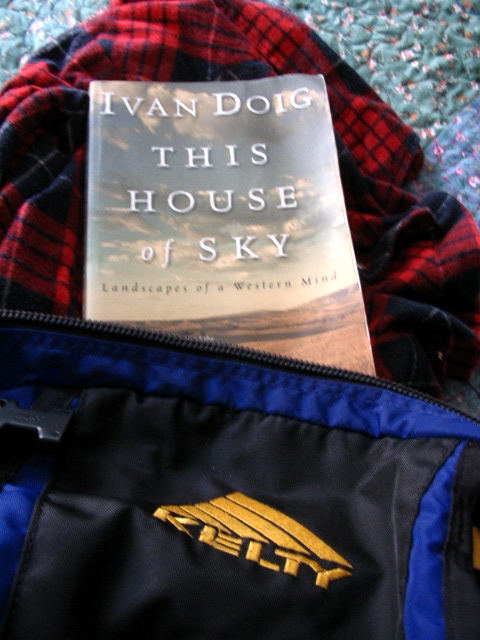
Review :: This House of Sky :: Ivan Doig


If you want to see the country, there's no advice better than that of Peter Jenkins: Go on foot, with your life strapped to your back and, hopefully, a friend and a good camera by your side.  There's no other way to get to know the breadth and depth of the land on a personal basis.

But if cross-country backpacking isn't for you, Greyhound is a good second. Maybe crowded, usually behind schedule, often hot, cramped, prone to arguments and the occasional fistfight, Greyhound pushes travel up in your face (and in your nostrils). It's a journey not simply through miles and landscape but through people, the ones who get on and off at each stop for a smoke and chance to stretch out their legs.

I've just returned from a few weeks by bus, a pilgrimage to my birthplace to help my family reroof their secondhand farmhouse. As the bus moved me from the treed hills of Wisconsin through the cornfields of Minnesota and the stark, unending sky of North Dakota, I completed another journey: Ivan Doig's memoir, This House of Sky. My dad lent me the book with a high recommendations two years ago, and I first peeled back its cover somewhere in eastern Montana, that time by car, as we drove home. Two summers later, the time had come to see Doig through to the end.

I'm glad I did. Making the rounds of White Sulphur Springs' bars and cafes with Doig, riding miles of potholed highways in the Smith River valley, fighting the windblown drifts high in the Big Belt Mountains--these are all pieces of life, memories and stories I share with Doig. These people, these places, this way of life brings me home.

Wednesday, June 16, 2010

Review :: Sacred Unions, Sacred Passions :: Dan Brennan

Lately I've been thinking about love, beauty, and limits. We know that there is no limit to beauty (God is unendingly beautiful). But beauty, as always a manifestation of love, exists because of limits, within limits. My life is beautiful not when I can escape from my workaday schedule, not when I ignore the demands of friends and lovers, not only when I attempt the superhuman. In other days I might call the interplay of beauty and limits balance (that is, before the term was emptied of meaning by the abuse of pop psychology).

There's another theory of beauty: beauty as excess, beauty as transgression. Sometimes this aesthetics claims a corner on the market for beauty as transcendent, but I won't buy into this monopoly. Beauty is what we make of our limitations, not just our escape from them. Phrased differently, we see beauty when we see the truth of our limitations, see them in a different light, see them in light of the resurrection.

One way of describing Dan Brennan's Sacred Unions, Sacred Passions: Engaging the Mystery of Friendship between Men and Women is to say it locates friendship (specifically cross-sex friendships) within these competing dynamics of beauty.  On the first page Brennan writes,
This book makes a simple claim: stories of paired cross-sex friendship love are journeys toward communion with God and our neighbor in the Christian story. In the new creation, men and women are not limited to stark contrasts where we must choose between romantic passion in marriage or inappropriate sex/infidelity. Chaste, but powerfully close friendships between the sexes stir our curiosity and resist formulaic gender roles in marriage, friendship, and society.
Beautiful cross-sex relationships, he argues, should not be bounded by the aesthetic ideology of excess. Relational beauty, it turns out, is a matter of balance, not sheerly of orgasm or roses and candy hearts.

Monday, June 7, 2010

Review :: Start Here :: Alex Harris & Brett Harris

I was twenty-one once. It seems like a long time ago, but it was only a handful (or two) of years ago. When I was twenty-one, I felt bright-eyed and bushy-tailed, befuddled by the responsibility of adulthood, that immense weight of making one's way in the world.

Alex and Brett Harris are twenty-one. (They are also, in fact, twin brothers and the younger siblings of Josh Harris--yes, that Josh Harris.) At twenty-one, they stand as my spiritual mentors of the moment. I find Start Here, their book, a challenge, the straight talk and the practical how-to suggestions to follow Jesus doing hard things in a big and often-overwhelming world.

Admittedly, I'm not their target audience. The Rebelution is about "a teenage rebellion against low expectations," not about guys pushing thirty finally owning up to Jesus' call to real world discipleship. Alex and Brett started TheRebelution.com when they were sixteen to inspire fellow teenagers to Do Hard Things (incidentally the title of their first book, published when they were nineteen).

In Start Here, Alex and Brett speak often of the "myth of adolescence," the lie that "the teen years are a time to goof off and have fun before 'real life' starts." It's this critical edge that catches me. They pick up on the insidious lies so big and institutionalized that most of us spend our teens and our twenties wandering around within their borders without even knowing these lies stretch out around us. Alex and Brett have seen something else, of Jesus and the kingdom life he brings, and up against it they can name the cardboard cutout substitutions we cling to.

Start Here takes up the practical and pastoral fall out of teens trying to Do Hard Things (a book I haven't read but hope to soon). Alex and Brett weave easygoing advice around stories, emails, and forum posts (from TheRebelution.com) by real live teens doing hard things. They walk through the challenges of where to start, what to do when things get hard, what to do with success, and how to maintain healthy relationships (with friends, family, and God) while doing hard things. These are, in honesty, questions I ask a lot. Where do I even start? Okay, so what now? How can I keep up this pace without having my marriage [friendships, spiritual life, fill in the blank] fall apart? Alex and Brett offer good advice, advice that I'm personally taking to heart.


Start Here also tugs at the youth pastor parts of my heart (I generally try to keep those heart parts segregated off from the rest of my heart because jr. highers are rambunctious and tend to make a mess). Start Here is written for teenagers, and it's a book they would read. Plus, it has good group discussion questions in an appendix. I plan to use this (along with Do Hard Things) as youth curriculum in the coming years.

Alex and Brett write a practical, pastoral, spiritual, challenging book. But they do right from a particular cultural vantage point. They are keenly socially attuned, relating stories of teens crocheting hundreds of hats for orphans or raising money to drill wells for villages in Africa. But some of the stories bear a particular political and cultural bent (starting a petition to censor sexual art on display at a high school; holding an anti-abortion event; etc.; many of the stories take place in Texas). All in all, though, their cultural interpretations of what God wants done in the world does not overwhelm or even taint the strong and clear challenge they offer to those of us stuck in adolescence.
Related Posts Plugin for WordPress, Blogger...