Showing posts with label prayer. Show all posts

Thursday, January 31, 2013

Notes from the Corner - Prayer Week - Prayer at the Table

One of the most common places I’ve heard prayer is around the dinner table. Even in fairly secular households, I’ve watched people pause for a moment before starting a meal.

I’m not sure why praying and eating tend to go together. It’s not a Bible command (though we do have examples of Jesus and others thanking God for food). My best guess is that sitting down together at the table reminds us again of the many good things in our lives. Prayer is a natural expression of gratitude.
An old name for the Lord’s Supper is eucharist (Catholics, Anglicans, and others still call it that). Eucharist is simply the Greek word for “thanksgiving.” Communion, like our mealtime prayers, is a way of saying “Thank you” to God.
When we come to this Table together, we have much to be thankful for. We are thankful that God’s thrown open his arms to welcome us back into God’s family. We’re thankful for the spilt blood and broken body of Jesus that made us a Way home. We’re thankful that we’re here together, brothers and sisters sharing a meal. We take this bread, take this cup, as joyful acts of praise and thanksgiving.

Wednesday, January 30, 2013

On Weeks of Prayer, Communion, and Fasting, Part 2


This is Part 2 in a three-part series on my experience of Prayer Week 2013. (See Part 1 for more details.)

Prayer Week in our fellowship involved increased times of gathered and personal or household prayer, some folks trying out fasting, and a concluding communion service the follow Sunday. These practices pushed me into some deep reflection on love, ours for God, God's for us, and our love together for the world.

I talked about this love and these practices on three consecutive Sundays. Here I'm returning to these topics, rehashing what I said and pushing deeper into each topic.

Week Two: Meeting Jesus in Prayer and at the Table

Something seemed right about ending a week of praying together with a Sunday morning eating together in memory of Jesus. As I prayed through the week, my conviction grew stronger and stronger that prayer and communion should go together in the life of our fellowship right now.

My mind also kept returning to the story of Jesus, now resurrected, surprising his listless disciples on the beach with hot breakfast on the beach. This passage isn't quite a communion story (though it echoes the eucharist in many ways), and prayer certainly isn't its main concern. Perhaps because my heart was in the last chapters of Jn for Prayer Week or perhaps because the Spirit had something important to say, but this story became the center of my meditations on prayer and communion for Sunday morning.

Praying over the passage, over the communion liturgy (which circled around 1 Cor 11, Jn 14, and Lk 15), and over the circumstances and hearts of our fellowship, I began to see that prayer and communion overlap in three significant ways.

1. In both prayer and communion, we encounter Jesus. Believers have long debated how exactly we meet Jesus at God's dinner table. But whatever the encounter's mechanics or metaphysics, we can't deny that in sharing in this bread, this cup, we encounter Jesus.

Prayer, too, whether we're conscious of it or not, is always in Jesus' name. We seek God's face, and we find the Incarnate Son. We seek God's  goodness to heal our diseases, God's wisdom to direct our steps, God's justice for the oppressed, God's forgiveness for our guilty hearts, and we find that all these things come to us in the person of Jesus. (See Jn 14.6-9)

(We could also say that when we go to God in thanksgiving, the very things we're giving thanks for have already faced us with Jesus. Both John and Paul say that Jesus is the order, the wisdom, the logos that secures goodness, order, shalom in the universe--whether that goodness be a warm dinner or a miraculous healing.)

2. Both prayer and communion strengthen our love for fellow believers. I saw this firsthand as our fellowship gathered in small groups to pray for one another on Wednesday night. (Thank you, Cindy, for leading us in that exercise.) Text messages, emails, actual face-to-face conversations followed up these shared prayer requests. Prayer increases our stake in other people's lives.

I find this morning by morning as my book of Common Prayer asks me to voice "Prayers for Others" before reciting the Our Father. Those I pray for work their way into my heart, and I find myself calling them up or sending an email to them.

Paul told the Corinthians that their eucharistic fellowship should reflect their true heart-felt fellowship with one another. For this lack of "discerning the body of Christ" to be present in those sisters and brothers eating with them, Paul said some were sick, even dead. Remember, Paul's teaching on the Lord's table in 1 Cor 11.17-34 comes only two or three paragraphs before his instruction about the church being one body made up of many members in 12.12-31.

If we are to eat this meal as a true testimony to the Messiah who submitted even to crucifixion to reconcile us to God (and one another), we must no longer be wrapped up in our own concerns but begin to privilege more the concerns of others (Phil 2.1-11).

3. Both prayer and communion send us out to love and serve the world. We share with one another at the communion table to proclaim the Lord's death until he comes (1 Cor 11.26). This meal is a witness to one who has begun to renew all things and who will return to complete that project. If we share with him at table, we must also share with him in life. He cared for the lonely, healed the sick, cast out evil. If we eat his food and look forward to enjoying the shelter of the homes he is preparing for us, we must live by his rules, after his example.

More fundamentally for me, communion is about a renewal, a recommitment to our discipleship. Every time I stand receive this bread and wine, I remember the promise I made with baptism. Jesus said, "Follow me," and I got up and followed.

Among the things that the example of the New Testament teaches us about prayer, perhaps one is that prayer is as much listening for God to speak as it is talking to God. Think of the the pre-Pentecost prayer meeting (Acts 2). Think of the one in Antioch (Acts 13): As they were worshiping the Lord and fasting, the Holy Spirit said, "Set apart for me Barnabas and Saul for the work to which I've called them." So after they prayed and fasted, they placed their hands on them and sent them off.

Praying to God means, in part, being ready for God to use us to answer our prayers.

All three of these dynamics are at work in Jn 21, even though neither prayer nor communion show up in the story. The disciples encounter Jesus on the shore. (Picking up week one's themes, Jesus shows them his goodness by filling their nets and bellies, even while there are deeper needs that won't be addressed until after they've finished eating.)

After the breakfast meeting, Jesus calls Peter aside. Peter needs relational repair work with Jesus. While Jesus was on trial, Peter had sworn by heaven and earth that he didn't even know who Jesus was. Jesus addresses that by asking Peter three times if he loves him. Jesus pushes Peter to a stronger love. (Although Jesus is the fellow believer in question here, the principle holds that an encounter with Jesus results in stronger commitment to right relationships within God's family.)

This encounter not only offers reconciliation; it also gives Peter a task: "Care for my flock." We think of Peter's commission primarily in terms of pastoral care of believers (a strong love), but this task had a strong missionary aspect. Jesus predicts at the end of the chapter how Peter will die: a martyr in Rome, far, far away from the shores of Galilee. Earlier, he was a guest in the first Gentile convert's house in Caesarea and a minister to the fledgling congregation in Antioch. Jesus sent him out to the nations.

In my view, Jn 21 opens the shared dynamics of prayer and communion beyond Prayer Week, church services, or focused times of prayer. Paul says, "Pray continually." It seem that we could continually, at any moment, meet Jesus, find him calling forth more love, hear him sending us to do something new. The spiritual and sacramental practices train us for a spiritual and sacramental awareness of all of life. Jesus may be standing on the shore, if only we have eyes to see him.

Tuesday, January 29, 2013

On Weeks of Prayer, Communion, and Fasting, Part 1

I am three Sundays into 2013. Between the first and the second Sunday (from 06 to 13 January) our fellowship devoted itself to prayer. Some fasted during those days. We ended the week by eating a communion meal together.

A January "Prayer Week," as it's called, is something of a Canadian Mennonite tradition, I'm told. It was new to me. The impulse seems to be (1) to give to God the first portion of the year and (2) to seek God's blessing and direction for the new year. [If you have more information on this tradition, I'd love to hear; share it in the Comments.]

Both these motivations are well and good. I know that our fellowship needs God's direction. We have hard work ahead of us, first discerning personally and corporately where the frontiers of God's reign are in our context and, second, going and doing whatever God shows us.

But I worry that the stated motivations for Prayer Week encourage us toward a tit-for-tat take on spiritual disciplines. It's not long before we're thinking, "Okay, God, I'll spend time praying to you so that you will bless/guide/protect me and mine."

So when we've met up for worship and encouragement on the last three Sunday, I've explored our reasons for praying, for eating the Lord's communion meal together, for fasting. I'm trying to preach more and more from notes (and less and less from manuscript), so I won't be posting sermons whole-text regularly (unless my attempts at note-preaching crash and burn). But here's a summary of where my heart has been as I've wrestled with these issues:

Week One: Why Should We Pray?

My home passage was Jn 17.1-5. (Others, including Cindy, led us in reflection on vv 6-19 and 20-26 at prayer meetings later in the week.)

Jesus uses "glory" language over and over in this paragraph. He "brought [his Father] gory on earth" and was glorified "with [his Father] before the world existed." At the same time, Jesus asks that his Father "glorify [his] Son, that [his] Son may glorify [him.]" The question is, What is glory?

My answer: Jesus glorifies his Father by revealing his Father's character, bringing his Father's presence, ha-shekinah, present on earth. What do we see when Jesus reveals his Father? My answer: love. John, in his first letter, states this plainly: "God is love. This is how God showed his love among us: He sent his one and only Son into the world that we might live through him" (1 Jn 4.8-9). Or, in the Gospel's paraphrase of Ex 34.6-7 in Jn 1.18, "We have seen his glory, the glory of the one and only Son, who came from the Father, full of chesed and `emet."

Understanding glory as the revelation of God's loving and faithful character, I came up with two basic motivations for prayer as I listened to Jn 17.1-5.

1. We pray because Jesus has already glorified his Father. We have experienced God's lovingkindness and faithfulness, in ways small and big. There are the common blessings that God pours out on the wicked and the good, the shalom we experience now, fractured and bent up as it may be. Ultimately, these are all reflections of the God's greatest act of love, the compassion and obedience that carried Jesus to a cross.

2. We pray because we ourselves, our neighbors, and our world still need God's glorious love to be revealed here and now for us. Having "tasted and seen that the Lord is good" heightens our awareness of how much is not yet good. Experiencing God's love turns up the contrast. Suddenly the ills, the violence we might have off-handedly chalked up to "that's just the way things are" become an aching hole, a wound in the otherwise infinite goodness, love, faithfulness, glory of God. With Jesus, we pray, "You have been glorified on earth, now glorify yourself again" (cf. Jn 17.1, 4 and 10.27-28)

(Watch for reflections on the next two weeks over the next few days)

Sunday, January 6, 2013

Notes from the Corner - Prayer Week - Teach Us to Pray

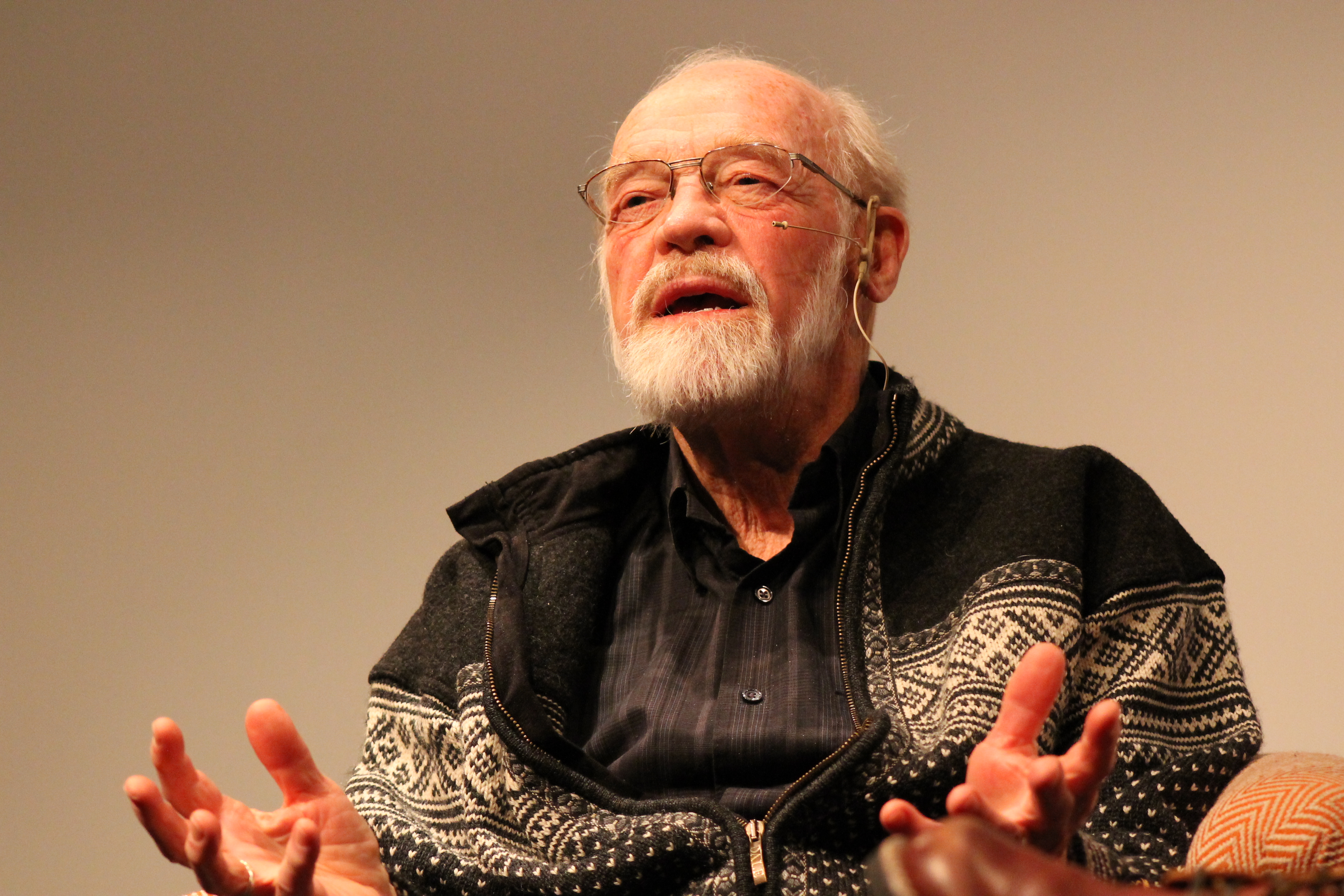
Eugene Peterson
Source:http://is.gd/v70AAI
In Tell It Slant, Eugene Peterson says, “The classic set prayers for Christians and Jews are the Psalms.” For Christians, he adds, this collection of prayers also includes Jesus’ prayers.

Set prayers, as Peterson calls them, are words others have prayed that we can use to guide our own prayers. He says, “It is a common and widespread practice in the Christian community to apprentice ourselves to the prayers that Jesus prayed.” Just like we learn to form our letters and numbers by copying those of others, so we can learn to pray by echoing Jesus’ prayers.
So, if you’d like learn to pray more honestly, more consistently, more powerfully, more like Jesus, begin with his prayers. They include the Lord’s Prayer (Mt 6:9-13/Lk 11:2-4), a prayer of thanksgiving (Mt 11:25-26/Lk 10:21), a prayer at a friend’s tomb (Jn 11:41-42), a few prayers as Jesus contemplates the cross (Jn 12:27-28; Mt 25.36-44/Mk 14:32-39/Lk 22:46), a prayer for his followers (Jn 17), and Jesus’ final words from the cross (Mt 27:46/Mk 15:34; Lk 23:34, 46; Jn 20:30).

Sunday, March 1, 2009

March 1 - The Disciples in Gethsemane: Quality Time

First Presbyterian Church of DuPage - 8:00 & 10:30 a.m.
Mark 14.32-50 - “The Disciples in Gethsemane: Quality Time”

Note: I had the great opportunity to preach at the Sunday morning services this week. The church, in good Presbyterian fashion, is going through a Lenten study series, this year on Gary Chapman's The Five Love Languages. Each week, a member of the pastoral staff has taken one of the love languages and sought to show how it is rooted in the gospel. Below is my meditation on Quality Time as a way of expressing love within the church community.

They went to a place called Gethsemane, and Jesus said to the disciples, “Sit here while I pray.” He took Peter, James, and John along with him, and he began to be deeply distressed and troubled. “My soul is overwhelmed with sorrow to the point of death,” he said to them. “Stay here and keep watch.”

Going a little farther, he fell to the ground and prayed that if possible the hour might pass from him. “Abba, Father,” he said, “everything is possible for you. Take this cup from me. Yet not what I will, but what you will.”

Then he returned to his disciples and found them sleeping. “Simon,” he said to Peter, “are you asleep? Could you not keep watch for one hour? Watch and pray so that you will not fall into temptation. The spirit is willing, but the body is weak.”

Once more he went away and prayed the same thing. When he came back, he again found them sleeping, because their eyes were heavy. They did not know what to say to him.
Returning the third time, he said to them, “Are you still sleeping and resting? Enough! The hour has come. Look, the Son of Man is betrayed into the hands of sinners. Rise! Let us go! Here comes my betrayer!”

Just as he was speaking, Judas, one of the Twelve, appeared. With him was a crowd armed with swords and clubs, sent from the chief priests, the teachers of the law, and the elders.
Now the betrayer had arranged a signal with them: “The one I kiss is the man; arrest him and lead him away under guard.” Going at once to Jesus, Judas said, “Rabbi!” and kissed him. The men seized Jesus and arrested him. Then one of those standing near drew his sword and struck the servant of the high priest, cutting off his ear.

“Am I leading a rebellion,” said Jesus, “that you have come out with swords and clubs to capture me? Every day I was with you, teaching in the temple courts, and you did not arrest me. But the Scriptures must be fulfilled.” Then everyone deserted him and fled.

During the season of Lent, we as a congregation are working through Gary Chapman’s The Five Love Languages. Our goal is to become better at communicating our love to other people. In Mark 12 verses 30 and 31, Jesus says God’s most important command to us is to love the Lord your God with all your heart and with all your soul and with all your mind and with all your strength. And the second most important, he says, is to love your neighbor as yourself (Mk 12.30-31). In John 15, Jesus puts it another way: My command is this: Love each other as I have loved you. Greater love has no one than this, that he lay down his life for his friends. You are my friends if you do what I command (Jn 15.12-14). God cares a lot about the love we show to others in our daily lives.

So how do we love? Is it a skill that we practice like scales on the piano? Does it take hard work to learn like polevaulting? Are we liable to get bruised and sore along the way? Yes, yes, and yes. But most of all, love is a choice to change the way we behave, to change what we do. Sometimes we think of love as a feeling, but love that stays in our heart is about as useless as a drug that cures cancer locked up in a top secret pharmaceuticals laboratory.

Last week Pastor Mark talked about how we can show love through the words we use. This week I want to talk about how we can show love through the way we spend our time. We need to learn to use our time lovingly in our relationships, parents with kids, parents with adult children, husbands to wives, friend to friend, dating couples, coworkers and strangers. But I don’t want our time together this morning to become simply a how-to laundry list. Instead I want us to dig down into the deepest heart of what it means for us to love one another by spending quality time together.

Jesus has already pointed the way toward the heart of all love. In Mark 12, he says the greatest commandment is that we love God with all our heart, all our soul, all our mind, and all our strength. Wherever we show love in our lives, in whatever relationships we’re in, underneath it all lies our obligation, unspoken, maybe unrecognized, to love God. If our love for anyone is to be true and real and good, it must spring from our loving relationship with God our Father.

Thursday, February 12, 2009

"Jason dreams of leaving home"


These are some of my favorite people in the world.  This is Jae and Rachel and their family.  You can find out a lot more about them on their blog.

They are going to Russia to work as missionaries.  They fly out in just a few days. I want to encourage all of you, especially those of you from the Five O'Clock Community, to pray for them. I know from experience that landing in a foreign country where one is going to live for the next however many months can be very challenging.  Pray for their accommodation to the new culture, for easy language learning, and, especially, for some close friends to walk and work and fellowship with them there.

Jae and I grew up together in Bozeman, Montana. We spent many early mornings sharing our faith and prayer with one another while drinking coffee at Perkins. We headed up attempts to get the Bible clubs on our high school campuses to work together to share Jesus' message with more people.  We even played in a band for a little bit. I am confident that God has amazing plans for Jae, his wife Rachel, and their daughters in Blagoveshchensk.
A few months ago, Jae and Rachel record an album of worship songs. They have it for free download on their blog here.  Download, and remember to pray for them whenever it plays.
Related Posts Plugin for WordPress, Blogger...