Monday, August 3, 2015

Monday, February 9, 2015

Highlighting

"In Christian history, however, some of the most significant heresies have been conservative rather than radical--the tendency to hold on to old theological answers when new questions have caused the main body of Christians to move on to new answer.

"[regarding Athanasius contr Arianism] the new answers he proposed were true to the direction of the Scriptures. 'Orthodoxy,' then, is not always the possession of those who try to hold on to the past. One may find a truer criterion in the direction toward which Christian thought has been tending."

Raymond Brown, The Comminity of the Beloved Disciple, 80-81.

I'm not willing to establish this as a dictate of theological or pastoral method. However, this insight definitely offers a big intellectual bite to chew on.

Tuesday, January 6, 2015

Highlighting

More from Richard Hays' Moral Vision of the New Testament, this time on Matthew:

"When we compare [Matthew's] teachings to the halakic rulings of the Mishnah or the detailed regulations for community life codified in the Community Rule of the Qumran covenanters (1QS), we can hardly help noticing the rather broad and incomplete character of Matthew's programmatic presentation [in the Sermon on the Mount]. As Wayne Meeks observers,
 ... [W]e  have here no system of commandments. The rules are exemplary not comprehensive, pointers to the kind of life expected in the community, but not a map of acceptable behavior. Still less does Matthew's Jesus state philosophical principles from which guidelines for behavior could be rationally derived. We are left with the puzzle that while Jesus plays the role of a conventional sage in Matthew, his teachings recorded here do not add up to an ethical system. It is not in such a program of teaching, apparently, that Matthew understands the will of God to be discovered.
Matthew's  rigorous summons to moral perfection cannot be rightly understood as a call to obey a comprehensive system of rules. Despite his emphasis on the church's commission to teach obedience to Jesus' commandments, Matthew sees such teaching as instrumental to a deeper goal: the transformation of character and of the heart." (98)

Really, I could quote most of Hays' chapter on Matthew. Each succeeding section unfolds another aspect of the ethics constructed by Matthew's narrative world so foundational, so basic to Matthew's vision, that I wonder why I've never seen it before.

For instance, the next section on the "hermeneutic of mercy" and the twice repeated (!) citation of Hosea 6.6 (Mt 9.13; 12.7) bowls over some of my gut-assumptions about Matthew. The high obedience ethic of the Gospel and the paltry character of "mercy not sacrifice" appeals in much contemporary literature.

Another money quote:

"In these passages [Mt 9.13 and 12.7] we see the outworking of Matthew's earlier claim in the Sermon on the Mount that Jesus fulfils rather than negates the Law. When that formula is applied to test cases, such as eating with sinners and harvesting grain on the Sabbath, we see that the Law is understood to bear witness to what Matthew elsewhere calls 'the weightier matters of the law: justice and mercy and faith' (22:23). Jesus' teaching provides a dramatic new hermeneutical filter that necessitates a rereading of everything in the Law in light of the dominant imperative of mercy." (100)

This is a beautiful chapter.

Sunday, January 4, 2015

Highlighting

From Richard Hays, The Moral Vision of the New Testament, 90.

"If God's self-disclosure takes the form of riddle and enigma, there can be no place for smugness or dogmatism in ethical matters. Those who think they have the rules firmly in hand are those who suffer from hardness of heart (Mark 3:1-6, 7:1-23). [Mark's] story's notorious lack of closure should engender openness in the readers. If our sensibilities are formed by this narrative, we will learn not to take ourselves too seriously; we will be self-critical and receptive to unexpected manifestations of God's love and power."

Monday, December 22, 2014

Highlighting

From the 2009 Antioch Gathering..,

"Abandon false gospels and re-embrace the Gospel of the Kingdom. The Kingdom is an invisible but very real political space ruled by Jesus the King that encompasses the entire created world – except the human race which is given a choice under whose rule to live life, Mammon or Jesus (Matth 6:24). Those humans that join and populate the Kingdom are the ones that are saved by grace, say farewell to Mammon and decide to place themselves voluntarily under his kingship in loving obedience, not merely saying “Lord, Lord” but doing what their King says. The Kingdom is essentially the domain of God’s uncontested rule. As such it is a disposition, not a destination. “The gospel” was originally the news that there is a new king; the main message of Jesus was exactly that: he is our new King and we are all invited to live in the Kingdom, not any longer under the domain of darkness. This is the essence of the Gospel of the Kingdom. In the history of the Church three false while incomplete gospels have gradually replaced the Gospel of the Kingdom: a) the evangelistic gospel of “come ye and be saved”; b) the pastoral gospel of “come ye and be safe” by joining our church or group; and c) the gospel of the teachers and theologians that created doctrinal systems of truths that can be correct, but lifeless. It is of ultimate importance that The Gospel of The Kingdom is rescued from its historic obscurity and re-embraced and resonated by all that belong to Christ.

If the Kingdom of God is to come, ours has to go. The three kingdoms that most violently fight against the Kingdom of God is a) the kingdom of self, our own drivenness by selffish ambition, a career mindset and the idea “what is in it for me”; b) our primary identity in the “kingdoms of we”, groups, labels, organizations or denominations that displaces everything else, including the Kingdom of God, to a rank of secondary priority; and c) the kingdom of nationalism, tribalism and patriotism, where our sworn or felt allegiance to an ethnic group, a political expression or a political preference stands in the way of our primary citizenship in the Kingdom." 

Monday, December 15, 2014

Just Love?

... reading a lot about sex lately. Well, about sexuality. A lot.

Our congregation is grappling with questions about our response and attitude toward LGBT Christians. I'm grasping for whatever handholds
might help us negotiate this pass with grace, justice, and fidelity.

One volume that's come into my hands is Margaret Farley's Just Love: A Framework for Christian Sexual Ethics.


JL does not take Christian LGBT sex ethics as its sole or even primary focus. Instead Farley takes on sexuality broadly.

I found the first three chs quite helpful. Farley provides a very readable yet in depth introduction to the last century of discourse surrounding sexuality. She next provides a historical overview of sex from the preSocrarics to Freud and beyond. Chapter 3 views sexuality cross culturally (though with the colonial character of our gaze always in mind). This introductory helpfully offers, at the least, one way of coming to grips with questions surrounding sexuality.

One hundred fifty pages further into JL's constructive project, I find Farley less helpful and less than compelling.

It's not that I disagree with key components of her framework. In fact, I find it hard to imagine an adequate ethics   that does not include like Do no unjust harm, Free consent of partners, Mutualiy, Equality, Commitment, Fruitfulness, Social justice.

For Farley these components grow from the twin core assumptions of autonomy and relationality. Again, this core resonates with something in my gut about the appropriate starting point for sex ethics.

But... But that's where JL loses its persuasive and illuminating power for me. Farley fails to develop here, even in thumbnail scale, any justification for the basic-ness of autonomy and relationality, either on philosophical or theological grounds. In reading JL I'm left with the reasonable suspicion that my cultural prejudices are being valorized as ethically basic, that my 21st century, USAmerican, middle class gut is somehow tuned most basically to justice.

I wish and hope that's the case (at least in these terms), but I need some further explanation to show me why it might be. So far JL has not mustered this sort of argument. But we'll see what develops in the final hundred or so pages.

Wednesday, July 10, 2013

The story of a Promise, a Prophet, and a Passion, Part 3

A bit of drama is good for a church's heart. I've read a few places that any good worship service should be dramatic, in one sense or another. Worship should tell a story--the story, if worship is good. And worship should tell this story in such a way that the events become present, after a manner, once more to those gathered. It's participatory theatre (or is it simply eucharistic?).

I believe scripture itself works a bit "eucharistically" or re-present-ationally. The latter stories of scripture retell or recapitulate the former.

So after weeks of retelling the Hebrew Bible's narrative of promise and purpose and another four weeks with that story enacted by the prophet Jonah, we told the story one more time (the final time? the ultimate time?) through a staged reading of John 18-19 on Good Friday.

I wasn't sure if the drama would get the enthusiastic participation telling the Good Friday story (= telling the promise & purpose story) would meet. But as our worship committee dove right in. One man built a rough-hewn, life-size cross out of cherry beams. Another woman dug through the dusty costumes in the church basement and her own sewing pile, while another collected various props. A contractor erected a beautiful empty door-frame. (Doors are very important in John's story!)

By rehearsal on Wednesday of Holy Week, our cast included nearly twenty people, ranging from their early seventies down to some girls in grade 3. We all were wrapped in bathrobes or old pillow cases. Some of us were comfortable with our lines. Some folks' hands and knees were shaking, nervous. As default director, I ran and jumped and shouted and waved my hands around, helping folks figure out when to enter, where to stand, or what my typo-ridden script was trying to communicate.

The performance on Friday morning was beautiful and appropriately tragic. Jesus was betrayed by friends and buried with strangers.

Beginning on the third day, we'd tell stories of resurrection (John offers plenty!). But on Friday morning, we left Jesus lying in the tomb while we went off to family gatherings or fasts.

The Bible begins with a promise. God says, "I love you and I will be with you." Jesus came restating that promise in his own words: "God's kingdom is arriving" and "a time is coming and has now come when the true worshipers will worship the Father in spirit and truth."

Along with that promise, humanity received a purpose. We were to image God, to care for everything that had been created just as God did. We refused that task, in the Garden and ever since. Jesus called us back to that purpose: "Repent and believe the Good News" and "whoever drinks the water I give him will never thirst; indeed, the water I give him will become in a him a spring of water welling up to eternal life."

At Golgotha we rejected that promise, that purpose once more. But at Golgotha, Jesus accepted it for us all. I think it was Karl Barth who first got me thinking about how even while Jesus is God-with-us, Jesus is also us-with-God. Jesus is the perfect human, the first person to receive God's promise in complete joy and to cooperate wholly with God's purpose.

Jesus' obedience unto death, even death on a cross, gives us one concrete point in history to point to and say, "That's what working with God looks like." The cross surely shows us the extent of God's love for a lost and sin-sick humanity. It also shows what one person's love for God looks like when it is really true.

At our Good Friday service I didn't sermonize. We simply performed the story and sang a few songs. I trust that the Spirit-inspired story preaches much better than I do. I'm not sure what people took away from that morning. I trust though that God was at work there, speaking God's good promise to us and directing us out into mission.

Tuesday, July 2, 2013

Forays in Civic Religion

When Jesus appeared in Galilee announcing the Good News, he said, "Believe the gospel: God's reign is arriving!" (see Mk 1.15)

When Peter outlined the same gospel after the Holy Spirit arrived during Pentecost, its heart was that the one who was crucified and resurrected has been made "both Lord and Messiah" (Act 2.36). Years later, when a vision directs him to the residence of a Roman centurion (the equivalent of an US Army captain), Peter states the gospel again: "God preached peace to the Israelites through Jesus Christ--this one is Lord of all" (Acts 10.36).

Paul has the same thing to say when he meets an overwhelmed Roman jailor after an earthquake in Philippi: "Believe in the Lord Jesus and you will be saved" (Acts 16.31). In his later letter to the house churches in Rome, he wrote, "If you confess with your mouth that Jesus is Lord and believe with your heart that God raised him from the dead, then you will be saved" (Ro 10.9).

The Good News has a great deal to do with Jesus being Lord (a title the Roman emperor like to claim, meaning master or ruler). The generations of believers that followed the NT saints often were penalized life itself for holding steadfastly to this claim. They wouldn't offer the incense to the emperor, because their allegiance was to another.

I believe the gospel still boils down to this bold assertion: that in every single area of human existence, God has made his Son and Messiah Lord and Ruler, and there is no other. Not President Obama. Not Prime Minister Harper. Not any part of the government or economy or culture of the Land of the Free or the True North, Strong and Free. My allegiance isn't to job creation or economic growth or security. Nor is my obedience commanded by advertising or brand loyalty. My allegiance, my obedience is to Jesus alone. No one else, nothing else has the right to make me pull out my credit card or take up arms. Jesus is Lord.

So when our local ministerial decided to host a Canada Day service in the park, I was a bit nervous. So often our public church service, especially during seasons of national enthusiasm, are nothing more than civic religion. (We burn incense to our Caesars in our own ways.) God's name gets inserted into blessings for us, against them, that reflect nothing of the divine heart we meet in Jesus. We praise the godliness of our leaders, living or dead, and attribute every good thing in our lives to the good moral quality and good deeds of our neighbors, in a tit-for-tat divine economy.

After talking with folks in our congregation, I went forward with participating in the service. One way to love our town is to be present for our group celebrations. I scrambled to put together a musical number for the morning. 

Then I sat down before a blank page, praying for the right words to say. 

You can read below what I came up with. I'm not sure I hit the mark, struck the proper balance between honest thanksgiving and prophetic reminder.

I can say that I'm thankful for how many of the other churches and pastors handled the morning. Civic religion dominated the morning, but at points speakers sounded through the noisy "Hail Caesars!" with words about Jesus and his call to generosity, care for the refugee, and prayer.

I'm curious to hear your stories about negotiating the sketchy terrain of religious ceremonies on national holidays. Let me know in the comments.

Check out my short talk after the jump.

Wednesday, May 22, 2013

The story of a Promise, a Prophet, and a Passion, Part 2

I enjoy flying, even with all the restrictions and even without much leg room. I enjoy flying because I get to look at the world from a new perspective. Through the airplane windows, I see the prairies or the mountains or the countless lakes spread out in every direction. (I like flying best when I get a window seat; otherwise, all my enjoyment leaves a crick in my neck.)

Our three-week overview of the Hebrew Bible was like the view from a plane. We were able to see the topography of God's promise, our purpose, and our rebellion from our altitude. But to really know the story, you need to travel through it at a walking pace, maybe even more slowly. Only then do your surroundings become more than postcard-potential scenery. Only then does the dirt cling to your skin and the events seep into your blood.

So for the next four weeks, we slowed down. We camped out with a prophet. We journeyed with Jonah.

If you grew up in churches like I did, you heard the story of Jonah from early on. It's a story made for children's books: wonderful illustrations, a good moral (especially if we only mind the first three chapters). I think the moral my Sunday School teachers drew from the prophet's story was usually along the lines of "Obey God" or "Don't run away from God." These are fine takes on the story as far as they go, but if we listen a bit more closely, we'll find the story is much, much richer.

A lot of people get hung up on whether Jonah is a true story or not. Was the prophet actually swallowed by a huge fish? Did an Assyrian emperor ever reign from Nineveh? I think there are good, biblical cases to be made for both sides: Jonah, the book, may be a prophetic biography or a prophetic parable. Either way, it's true to what God intends it to be.

(There are also bad cases made for both sides. For example, the fact that being swallowed by a fish alive is unlikely or even impossible is not a good reason to reject the story as historically reliable. If God can raise a dead man to life, certainly God can preserve the life of a prophet within a fish. On the other hand, just because a book is in the canon, it doesn't mean it's a history book. No one looks askance at Jesus' parables because they're fictitious.)

I think Jonah's story parallels the story of the kingdom of Israel (where he worked, see 2 Ki 14.25) to an uncanny degree. Just like the Israelites corporately, Jonah was given a purpose by God (Jnh 1.2), and just like the Israelites, he rejected it because he thought he knew better than God. 

Jonah, as we learn in 4.2, believed he knew more about who deserved punishment and blessing than God did. In 2 Ki 14.23-27, we hear that in Jonah's days, Israel was sitting pretty on the international scene because of God's blessing. A bit of historical digging (shout out to K. Lawson Younger, who taught me a lot about Jonah's context) turns up the fact that the world empire, Assyria, was in something of political recession. The kingdom of Urartu to the mountainous north of Nineveh, one of Assyria's powerhouse cities, was distracting the Assyrian emperor's empire-building troops from the backwaters of Israel and Judah. My guess is that Jonah the prophet interpreted these events as blessings for God's chosen and punishment on their oppressors. So when God's message came to warn Nineveh about it's impending judgment, Jonah thought God must be confused.

The Israelites made the same kind of high-handed judgments about God's purpose for them over and over again in their history. Even before the tribes split into competing kingdoms, David interpreted blessing on his reign as license to throw around kingly weight (skim the progression of events form 2 Sam ch 5 to ch 12; see also 2 Sam 24). It was this same ego/ethno-centric outlook that led to the split of the kingdoms. Rehoboam saw his father Solomon's wealth as proof that oppressive taxation, forced labor, and imperial aspirations were the way to go. With his announcement in 1 Ki 12.13-14 leads to mass rebellion and civil war. Similarly (and key to the northern Israel-ite Jonah's story), when the tribes of the agriculturally-rich north chose Jeroboam as rebel leader, fulfiling God's promise (1 Ki 11.26-40; 12.2, 20), Jeroboam took it as justification to shore up his political position by displacing the Jerusalem temple with two golden bulls as sites to worship Yahweh.

Everywhere in the Israelites' story we have see people thinking their plans are better than God's. And that's what Jonah does. Rather than traveling east to preach repentance to the Assyrians, he boards a ship headed west to the end of the earth.

But God doesn't simply let him go. Nor does God wipe him out. God sends a furious storm, but the storm never sinks the boat. Surely the God who split the Red Sea would have no trouble capsizing a ship.

No, instead God sends the storm as discipline, as a painful and costly reminder of Jonah's purpose in God's plans. This is a tactic we watch God employing over and over again, beginning in Judges. In Jdg 2.13-14, we hear,
[The Israelites] aroused Yahweh's anger because they forsook him and served Baal and the Ashtoreths. In his anger against Israel Yahweh gave them into the hands of raiders who plundered them. He sold them into the hands of their enemies all around, whom they were no longer able to resist.
But as Heb 12.4-11 explains, discipline is not destruction. Discipline is the way a loving God calls us back to our senses. The letter to the Hebrews quotes Prov 3.11-12 in this passage: My son, do not despise Yahweh's discipline, and do not resent his rebuke, because Yahweh disciplines those he loves, as a father the son he delights in. Discipline for the Israelites was a sign of God's devotion to them, of God's refusal to let them walk away from their purpose. The storm, as surely as the fish, was a means of salvation for Jonah.

If we remember Jonah's story at all, we know that Jonah eventually admits his miscalculation (But does he admit his fault?) and is thrown into the raging waters. If the storm is one picture of God's ferocious love for us, the great fish is another. The fish saves Jonah from drowning.

The hymn Jonah sings in the fish shows that Jonah still understands himself to be part of God's chosen people. Even though Jonah rebels against God's reason for choosing a people, Jonah is still part of it. Yahweh is the God he calls to for help (Jnh 2.2). In the same way, even though  Jeroboam set up idols to replace God's temple, he still understood the northern Israelites to be worshiping Yahweh.

(There's a lesson in this for us today: We worship Jesus in name, but is our worship the kind of worship God desires, the kind that Jesus lived and died and rose again to make possible, see Jn 4.21-24. There's a difference betweens sing about Jesus and singing with Jesus on the way.)

In ch 3, Jonah knows he can't escape God. He puts his hand over his mouth and complies with God's (wrong-headed, in his opinion) desire to warn the Assyrians about divine punishment. Jonah travels the 500 plus miles to Nineveh. When he preaches, the people amazingly repent.

This is perhaps the most profound wonder in the story! Why should the great and powerful Assyrians fear the wrath of a god who was once their vassal? Yet they do, with a fervor that sets them up as a model of repentance even for God's people. (Jonah is read in the afternoon prayer service in some synagogues on Yom Kippur.)

Jonah disappears from the story for a while. Strangely enough, when Jesus talks about the sign of Jonah  in Lk 11.29-32, he singles out the repentance of the people of Nineveh. I've often heard that passage taught as drawing a parallel between Jonah's three days in the fish and Jesus' days in the tomb (which Jesus does mention in Mt 12). But here, the lesson for the sign-seekers seems lies in the repentance of the people of Nineveh. Whatever the Ninevehites learned from Jonah, that is what people in Jesus' day and in our day need to learn from Jesus.

Back in Jnh 4, the focus shifts to what Jonah failed to learn from Nineveh (and also from the storm, the sailors, and the fish). This is a lesson about God's mercy--something Jonah confesses quite orthodoxly in 4.2. Yahweh, gracious and compassionate, slow to anger and abounding in love, a God who relents from sending calamity, is something of a creedal statement in the Hebrew Bible (see Ex 34.6-7, Ps 145.8, Joel 2.13). Jonah gets his theology right, but he misunderstands his place in that theology.

If the OT is about God calling (anointing?) a chosen few to help God keep the original promise despite our rebellion, then Jonah stands as a foil, a counterexample that shows how we, then and now, so often misunderstand God's plans. God called and commissioned Abraham to be blessed and to be a blessing, that through his and Sarah's family, all the families of the world would be blessed. By the time we hear Jonah's story, the prophetic representative of the people balks at God's question, "Should I not have concern for the great city Nineveh, in which there are more than a hundred and twenty thousand people who cannot tell their right hand from their left--and also many animals?" (4.11).

The question for our band of believers whether we'll follow Jonah or Jesus. Jesus is the first shining narrative example in scripture of someone giving away every blessing they receive for the benefit of others. The Spirit is poured into Jesus as baptism, and after resurrection, he pours the Spirit out on his followers, telling them to pour out that same Spirit on all flesh (see Jn 20 and Acts 2). Jonah understood salvation and election to be a matter of personal gain; Jesus shows it to be one first and foremost of generosity and love, even love unto death.

That's where our fellowship went next: to Jesus's death and glorious reward.

Monday, April 15, 2013

The story of a Promise, a Prophet, and a Passion, Part 1

It's been a few silent months since Prayer Week! Life in our fellowship has been full, very full. Here's an update:

Weeks spent in prayer prayer, communion, and fasting brought me to one question: "How is God asking us to share in Christ’s self-sacrifice in order that we can share his love with our sisters, brothers, and neighbors?"

It's a question of purpose, a question about the mission God gave Jesus and Jesus passed on to us.

What better to begin looking for an answer than to return to the Scriptures that revealed Jesus' purpose. Starting in Genesis, our fellowship spent three weeks tracing out God's purpose for God's partner people in the Hebrew Bible.

(Daniel Erlander's Manna and Mercy offers a great starting point for a mission- or purpose-oriented way of reading the Israelites' story. I'm also thankful for the gift of Leslie Newbigin's The Open Secret from a dear friend in Chicago. Newbigin offers a second, fuller perspective on this question of purpose and scripture--though The Open Secret focuses much more on the New Testament.)

This story, in my view, begins with a promise: God promises to be with the world God created by means of the God's image in humanity (see Gen 1.26-28). God's instructions to rule/care for creation fill out the way imaging God mediates God's presence and love to all the world. (After our great rebellion, this mediating function gets passed first to a family/nation then to a tent/temple and finally to an individual person and, through him, back to a renewed humanity; where and when these transitions occur is difficult to pin down, but the dynamic is clearly present.)

As you can see, you can't talk about God's promise for any length of time without beginning to talk about the purpose for humanity that accompanies it. Right relationship with God always seems to be partnership.

We traced out what happened when humanity rebelled, disregarding God's project for the lure of choosing our own. ("You shall be like God. . ." said the snake.) Rejecting our role in God's good rule, we found out that there are other forces eager to hold sway over us: death, conflict, fear, sin, Satan. The first story after our exit from the Garden is about fear, jealousy, and death rupturing the relationship between brother and brother (see Gen 4). If we read on through to Gen 11, we hear story after story of the good things God gave us--like technology, dignity, sex, language--one by one turning against us, seeking to snuff out our life. God's good world has been turned upside-down!

Quickly it becomes clear that if God means to keep the promise about being with us and caring for us, God is going to need first to rescue us from the mess we've made. I suppose that God might of done this in a flash from the sky--a happier version of Noah's thunderstorm. But in the story that we have, God continues to work with the creation story logic of mediation: He calls a family, Abraham's family, to bring God's blessing back to the world. They will pick up and dust off the forgotten image of God, so to speak. They sign back on to the role of being God's partners, God's co-workers.

The story is long and complicated. The partner people themselves are soon overcome, first by famine and then by Egyptian slave-masters and warlords, always by their weak hearts. Abraham's descendants, the Israelites, are slaves to the false-god Pharaoh and the Egyptian pantheon.

God again sends a mediator of God's care, concern, and, now, salvation: Moses. Moses brings God's deliverance to the Israelites; now they're free to do God's will. God leads them to the holy mountain to give them instructions about how to live as a freedom people, as God's co-workers in liberation and love.

But, it turns out, the rebellious spirit of Adam and Eve is still alive and well in the hearts of even the partner people. While Moses takes down God's how-to manual, the people rebel and begin living by the old Egyptian logic of slave and master, greedy for power, bowing down to whatever so-called god would give them a leg up on the surrounding nations. (I think of the golden calf debacle, but Ex through Num is full of stories of rebellions and hankerings for the old Egyptian way of living.)

Unfortunately things don't get any better once the people finally make it Canaan. It could have been freedom land, but the Israelites reject God's plans and maintain it as the gameboard of competing (Canaanite then Israelite) warlords' power plays. We can already trace the pattern in Judges--the cycle of giving up God's ways for those of the warlord nations, God's discipline by invasion, the appeal for God's help, God's loving mercy to send yet another deliver, and a season of peace before again walking away. The cycle keeps spinning all the way through Samuel and Kings, even the lives of rulers who start out godly, like David, but end up taking wives and killing off competitors and amassing wealth and weapons just like any other warlord.

Through this all, God remains committed to God's promise and purpose. This shows up as discipline--the invasion of Philistines, the split of the Israelite kingdom, the conquest by Assyria and finally by Babylon. God is not willing to let the partner people walk away. God keeps calling them back to Godself. (Read Habakkuk.)

Over we three weeks I told this story to our fellowship, pausing to recount the tales of Bible characters who put tragic flesh on this skeleton of God's purpose and our rebellion. It's a rich story, full of sub-plots and foreshadowing and surprising reversals. It's a story that produced some beautiful poetry and sagely reflection in the Wisdom books. The Prophets often help point out the bones of God's promise and purpose, but they introduce their own complications as well. Telling this story is the work of lifetime; I had to skip a lot to condense it to three weeks.

To offer a taste of the richness of the story, we spent the next four weeks meditating on one character's story within this grand story, the story of a prophet. More on that next time . . .

Saturday, March 9, 2013

On Weeks of Prayer, Communion, and Fasting, Part 3

This if the final installment, Part 3, of my reflections on beginning this year with prayer, communion, and fasting. (You may also be interested in Part 1 or Part 2.)

Prayer Week is apparently a Canadian Mennonite tradition; fasting is not. When I first floated the idea of inviting folks in our fellowship to join me in daytime fasting during Prayer Week, I met with quizzical expressions. This would be something new. On the first Sunday I suggested that maybe someday soon I'd do a bit more substantial teaching on the topic. Frankly, I didn't expect anyone to actually join me in this discipline. I thought about foregoing the fast.

I'm glad I didn't, for two reasons. First, people joined me in fasting. I think this was a bit of an experiment for some of them. I heard good reports back--God met them in their fast. Alongside this fellowship and growth among those who kept the fast, a number of good discussions cropped up about fasting when I was visiting folks who didn't opt to try out this discipline (ironically, those conversations consistently happened around dinner tables).

My second reason is that it was in my fast--more than in prayer alone or even at the communion table--that I encountered God during Prayer Week.

My hope for our fellowship during this week was that God would illumine the path forward for us in 2013: What relationships, what sacrifices, what celebrations is God leading us to as we witness to God's kingdom? I didn't walk away from this week with a clear and distinct vision or game plan, but in my hunger and, especially, in my fellowship with other fasting folks, I felt the seeds of a vision being pushed down into our hearts. We're still waiting for them to sprout. They're germinating now. They're still just an intuition too fragile for words. But I they are there, hopefully in good soil, waiting on God's time to waken them.

On the third Sunday I followed through on my promise to teach on fasting. This was a difficult decision. Like I've said, fasting is not a Mennonite practice. Also, preaching on fasting would mean sharing a lot of my own practice of fasting. I'm slow to draw attention to myself in this way. After all, Jesus said that it's what's done in secret that will be reward by the Father who sees into the secret places (Mt 6.18).

In the end I did, to some degree, preach on fasting. And, yes, my own fasting journey featured front and center (personal stories, after all, make for good introductions). But this sermon grew to be about something more than fasting.

So a bit of my story: I first personally encountered the practice of fasting when my high school youth group took on WorldVision's 30 Hour Famine. (It's a great project; I highly recommend trying it out!) My initial approach was more or less mercenary: if I give up food I can raise money so hungry people can eat. But in the wee hours midway through a youth group all-nighter, my fast became something spiritual for me. I'm not sure if it was my youth pastor's meditations on Jesus' forty day fast in the desert or simply the Spirit at work. Either way, by the time we all broke our fast with a simple beans 'n' rice meal at six p.m. the next day, I knew that I had met with God in a new way.

At that same time I was a student leader with Youth Alive, a student led Christian organization in my high school. Every now and again we'd hold evangelistic rallies like See You at the Pole. I thought it was a small step from fasting for people's material needs to fasting for their "spiritual needs." (I wouldn't make the same distinctions today, but I still believe my heart was on the right track.) I would make all sorts of sacrifices, takes all sorts of risks to talk with my friends about Jesus. Giving up food for a day or two didn't didn't seem like much of a sacrifice if it brought my friends closer to God.

A few years at university challenged my understandings of fasting, evangelism, all sort of things. Reading a few chapters of medieval or colonial church history will sour you on all sorts of things. I saw the abuses, the legalism, the way fasting (or evangelism or Bible reading) became a shibboleth on occasion. Still, something kept drawing me back to fasting. On my evangelical college campus, evangelism wasn't my prime purpose. Rather, I began to find that when I fasted, things would take on a certain clarity, they would bear a heightened urgency. I'm sure some of this was manipulatively self-produced, but I'm equally sure that at points God used a fast to clear away my collegiate haze of textbooks, flirting, coffee cups, and too many video games.

As I was preparing, revisiting my history, I kept stumbling into a bit of scripture that was very important to me then but that I probably haven't run into in six or seven years: 2 Cor 1.3-7.
Praise be to the God and Father of our Lord Jesus Christ, the Father of compassion and the God of all comfort, who comforts us in all our troubles, so that we can comfort those in any trouble with the comfort we ourselves receive from God. For just as we share abundantly in the sufferings of Christ, so also our comfort abounds through Christ. If we are distressed, it is for your comfort and salvation; if we are comforted, it is for your comfort, which produces in you patient endurance of the same sufferings we suffer. And our hope for you is firm, because we know that just as you share in our sufferings, so also you share in our comfort.
During late high school and throughout college, this was something of a life verse for me. Open your eyes to the pain of the world, the pain of your peers, and then bring God's solace. Bind up wounds, listen to hurts, dry tears--all with the gospel of Jesus.

A quote by Peter Holmes in The Fasting Journey also shed some unexpected light. He writes, "Throughout a fast you need to see your life as prayer."

On Sunday morning I talked through the basics of fasting: what it is (choosing to refrain from certain things), what can we fast (anything that reveals our dependency on God), who should fast (only those who are medically able).

But when we got to the Why of fasting, I had to slow down. Why fast--the inner logic of fasting, its spiritual dynamics--felt like the heart of what God has to say to our fellowship in this season.

Another quote from Holmes' The Fasting Journey offered a bit of jumping off point:
"The purpose of fasting must be considered from two perspectives. One is the benefit it brings to us personally in our relationship with God. But the other is the wider benefit it brings to the Kingdom of God. Sometimes the latter does not directly profit us. Fasting is often a way of paying the price in order that others may benefit."
Paying the price that others may benefit. This idea resonates deeply with Paul's explanation that if we are distressed, it is for your comfort and salvation. 

There's a kind of messianic, Suffering Servant logic to fasting.

Sure, giving up food (or Facebook or television or our morning coffee) peels back the layers of creature comforts that insulate us and distract us from God's voice. Self-restraint helps our spiritual sensitivity grow. At times we need this desperately, like when we repent.

But for our fellowship, it's the messianic aspect of fasting that whispers of where God is leading us.

Truth be told, this messianic kind of suffering is at work in much more than just fasting. The practice of fasting, it turns out, is shorthand for, a symbol of the missional character of Christian discipleship. Jesus has called us together to witness to God's kingdom. God sees the world's suffering, and, rather than turn a blind eye, God chooses to take that suffering on himself in Jesus so that God can renew all things, replacing suffering with comfort. Our witness to this has the same shape as Jesus' witness--we take suffering on ourselves to bring others comfort. Every bit of our lives ought to be caught up in this witness work. When we forget that, fasting reminds us that chosen suffering for the good of others is the way of love.

I'll end this post with the words I ended with on Sunday morning. Here's my conclusion:
Fasting is one way--a very intimate way--to share Jesus’ physical hardship: his own fasting in the desert, the late nights and early mornings he spent preparing for ministry, the days when healing the sick and casting out demons kept him so busy he couldn’t eat, even the suffering he faced as he walked toward Golgotha and then hung on a tree. There are other ways to deny ourselves to take part in his work.

But we must never forget that the purpose of Christ’s self-sacrifice as well as our own is so that we can give away God’s love more freely to those around us. That is the broader picture. Without that in view, our fasting or spiritual practices are no better than those of the Pharisees which God detested.

This is the question I want you to contemplate this week: How is God asking you to share in Christ’s self-sacrifice in order that you can share his love with your sisters, brothers, and neighbors? This is a question I put to you personally. It is also a question for our church fellowship: How is God asking us to deny ourselves for the sake of sharing his love with our neighbors here in our town and those around the world?

Pray on this. Pray with me.

Thursday, January 31, 2013

Notes from the Corner - Prayer Week - Prayer at the Table

One of the most common places I’ve heard prayer is around the dinner table. Even in fairly secular households, I’ve watched people pause for a moment before starting a meal.

I’m not sure why praying and eating tend to go together. It’s not a Bible command (though we do have examples of Jesus and others thanking God for food). My best guess is that sitting down together at the table reminds us again of the many good things in our lives. Prayer is a natural expression of gratitude.
An old name for the Lord’s Supper is eucharist (Catholics, Anglicans, and others still call it that). Eucharist is simply the Greek word for “thanksgiving.” Communion, like our mealtime prayers, is a way of saying “Thank you” to God.
When we come to this Table together, we have much to be thankful for. We are thankful that God’s thrown open his arms to welcome us back into God’s family. We’re thankful for the spilt blood and broken body of Jesus that made us a Way home. We’re thankful that we’re here together, brothers and sisters sharing a meal. We take this bread, take this cup, as joyful acts of praise and thanksgiving.

Wednesday, January 30, 2013

On Weeks of Prayer, Communion, and Fasting, Part 2


This is Part 2 in a three-part series on my experience of Prayer Week 2013. (See Part 1 for more details.)

Prayer Week in our fellowship involved increased times of gathered and personal or household prayer, some folks trying out fasting, and a concluding communion service the follow Sunday. These practices pushed me into some deep reflection on love, ours for God, God's for us, and our love together for the world.

I talked about this love and these practices on three consecutive Sundays. Here I'm returning to these topics, rehashing what I said and pushing deeper into each topic.

Week Two: Meeting Jesus in Prayer and at the Table

Something seemed right about ending a week of praying together with a Sunday morning eating together in memory of Jesus. As I prayed through the week, my conviction grew stronger and stronger that prayer and communion should go together in the life of our fellowship right now.

My mind also kept returning to the story of Jesus, now resurrected, surprising his listless disciples on the beach with hot breakfast on the beach. This passage isn't quite a communion story (though it echoes the eucharist in many ways), and prayer certainly isn't its main concern. Perhaps because my heart was in the last chapters of Jn for Prayer Week or perhaps because the Spirit had something important to say, but this story became the center of my meditations on prayer and communion for Sunday morning.

Praying over the passage, over the communion liturgy (which circled around 1 Cor 11, Jn 14, and Lk 15), and over the circumstances and hearts of our fellowship, I began to see that prayer and communion overlap in three significant ways.

1. In both prayer and communion, we encounter Jesus. Believers have long debated how exactly we meet Jesus at God's dinner table. But whatever the encounter's mechanics or metaphysics, we can't deny that in sharing in this bread, this cup, we encounter Jesus.

Prayer, too, whether we're conscious of it or not, is always in Jesus' name. We seek God's face, and we find the Incarnate Son. We seek God's  goodness to heal our diseases, God's wisdom to direct our steps, God's justice for the oppressed, God's forgiveness for our guilty hearts, and we find that all these things come to us in the person of Jesus. (See Jn 14.6-9)

(We could also say that when we go to God in thanksgiving, the very things we're giving thanks for have already faced us with Jesus. Both John and Paul say that Jesus is the order, the wisdom, the logos that secures goodness, order, shalom in the universe--whether that goodness be a warm dinner or a miraculous healing.)

2. Both prayer and communion strengthen our love for fellow believers. I saw this firsthand as our fellowship gathered in small groups to pray for one another on Wednesday night. (Thank you, Cindy, for leading us in that exercise.) Text messages, emails, actual face-to-face conversations followed up these shared prayer requests. Prayer increases our stake in other people's lives.

I find this morning by morning as my book of Common Prayer asks me to voice "Prayers for Others" before reciting the Our Father. Those I pray for work their way into my heart, and I find myself calling them up or sending an email to them.

Paul told the Corinthians that their eucharistic fellowship should reflect their true heart-felt fellowship with one another. For this lack of "discerning the body of Christ" to be present in those sisters and brothers eating with them, Paul said some were sick, even dead. Remember, Paul's teaching on the Lord's table in 1 Cor 11.17-34 comes only two or three paragraphs before his instruction about the church being one body made up of many members in 12.12-31.

If we are to eat this meal as a true testimony to the Messiah who submitted even to crucifixion to reconcile us to God (and one another), we must no longer be wrapped up in our own concerns but begin to privilege more the concerns of others (Phil 2.1-11).

3. Both prayer and communion send us out to love and serve the world. We share with one another at the communion table to proclaim the Lord's death until he comes (1 Cor 11.26). This meal is a witness to one who has begun to renew all things and who will return to complete that project. If we share with him at table, we must also share with him in life. He cared for the lonely, healed the sick, cast out evil. If we eat his food and look forward to enjoying the shelter of the homes he is preparing for us, we must live by his rules, after his example.

More fundamentally for me, communion is about a renewal, a recommitment to our discipleship. Every time I stand receive this bread and wine, I remember the promise I made with baptism. Jesus said, "Follow me," and I got up and followed.

Among the things that the example of the New Testament teaches us about prayer, perhaps one is that prayer is as much listening for God to speak as it is talking to God. Think of the the pre-Pentecost prayer meeting (Acts 2). Think of the one in Antioch (Acts 13): As they were worshiping the Lord and fasting, the Holy Spirit said, "Set apart for me Barnabas and Saul for the work to which I've called them." So after they prayed and fasted, they placed their hands on them and sent them off.

Praying to God means, in part, being ready for God to use us to answer our prayers.

All three of these dynamics are at work in Jn 21, even though neither prayer nor communion show up in the story. The disciples encounter Jesus on the shore. (Picking up week one's themes, Jesus shows them his goodness by filling their nets and bellies, even while there are deeper needs that won't be addressed until after they've finished eating.)

After the breakfast meeting, Jesus calls Peter aside. Peter needs relational repair work with Jesus. While Jesus was on trial, Peter had sworn by heaven and earth that he didn't even know who Jesus was. Jesus addresses that by asking Peter three times if he loves him. Jesus pushes Peter to a stronger love. (Although Jesus is the fellow believer in question here, the principle holds that an encounter with Jesus results in stronger commitment to right relationships within God's family.)

This encounter not only offers reconciliation; it also gives Peter a task: "Care for my flock." We think of Peter's commission primarily in terms of pastoral care of believers (a strong love), but this task had a strong missionary aspect. Jesus predicts at the end of the chapter how Peter will die: a martyr in Rome, far, far away from the shores of Galilee. Earlier, he was a guest in the first Gentile convert's house in Caesarea and a minister to the fledgling congregation in Antioch. Jesus sent him out to the nations.

In my view, Jn 21 opens the shared dynamics of prayer and communion beyond Prayer Week, church services, or focused times of prayer. Paul says, "Pray continually." It seem that we could continually, at any moment, meet Jesus, find him calling forth more love, hear him sending us to do something new. The spiritual and sacramental practices train us for a spiritual and sacramental awareness of all of life. Jesus may be standing on the shore, if only we have eyes to see him.

Tuesday, January 29, 2013

On Weeks of Prayer, Communion, and Fasting, Part 1

I am three Sundays into 2013. Between the first and the second Sunday (from 06 to 13 January) our fellowship devoted itself to prayer. Some fasted during those days. We ended the week by eating a communion meal together.

A January "Prayer Week," as it's called, is something of a Canadian Mennonite tradition, I'm told. It was new to me. The impulse seems to be (1) to give to God the first portion of the year and (2) to seek God's blessing and direction for the new year. [If you have more information on this tradition, I'd love to hear; share it in the Comments.]

Both these motivations are well and good. I know that our fellowship needs God's direction. We have hard work ahead of us, first discerning personally and corporately where the frontiers of God's reign are in our context and, second, going and doing whatever God shows us.

But I worry that the stated motivations for Prayer Week encourage us toward a tit-for-tat take on spiritual disciplines. It's not long before we're thinking, "Okay, God, I'll spend time praying to you so that you will bless/guide/protect me and mine."

So when we've met up for worship and encouragement on the last three Sunday, I've explored our reasons for praying, for eating the Lord's communion meal together, for fasting. I'm trying to preach more and more from notes (and less and less from manuscript), so I won't be posting sermons whole-text regularly (unless my attempts at note-preaching crash and burn). But here's a summary of where my heart has been as I've wrestled with these issues:

Week One: Why Should We Pray?

My home passage was Jn 17.1-5. (Others, including Cindy, led us in reflection on vv 6-19 and 20-26 at prayer meetings later in the week.)

Jesus uses "glory" language over and over in this paragraph. He "brought [his Father] gory on earth" and was glorified "with [his Father] before the world existed." At the same time, Jesus asks that his Father "glorify [his] Son, that [his] Son may glorify [him.]" The question is, What is glory?

My answer: Jesus glorifies his Father by revealing his Father's character, bringing his Father's presence, ha-shekinah, present on earth. What do we see when Jesus reveals his Father? My answer: love. John, in his first letter, states this plainly: "God is love. This is how God showed his love among us: He sent his one and only Son into the world that we might live through him" (1 Jn 4.8-9). Or, in the Gospel's paraphrase of Ex 34.6-7 in Jn 1.18, "We have seen his glory, the glory of the one and only Son, who came from the Father, full of chesed and `emet."

Understanding glory as the revelation of God's loving and faithful character, I came up with two basic motivations for prayer as I listened to Jn 17.1-5.

1. We pray because Jesus has already glorified his Father. We have experienced God's lovingkindness and faithfulness, in ways small and big. There are the common blessings that God pours out on the wicked and the good, the shalom we experience now, fractured and bent up as it may be. Ultimately, these are all reflections of the God's greatest act of love, the compassion and obedience that carried Jesus to a cross.

2. We pray because we ourselves, our neighbors, and our world still need God's glorious love to be revealed here and now for us. Having "tasted and seen that the Lord is good" heightens our awareness of how much is not yet good. Experiencing God's love turns up the contrast. Suddenly the ills, the violence we might have off-handedly chalked up to "that's just the way things are" become an aching hole, a wound in the otherwise infinite goodness, love, faithfulness, glory of God. With Jesus, we pray, "You have been glorified on earth, now glorify yourself again" (cf. Jn 17.1, 4 and 10.27-28)

(Watch for reflections on the next two weeks over the next few days)

Sunday, January 6, 2013

Notes from the Corner - Prayer Week - Teach Us to Pray

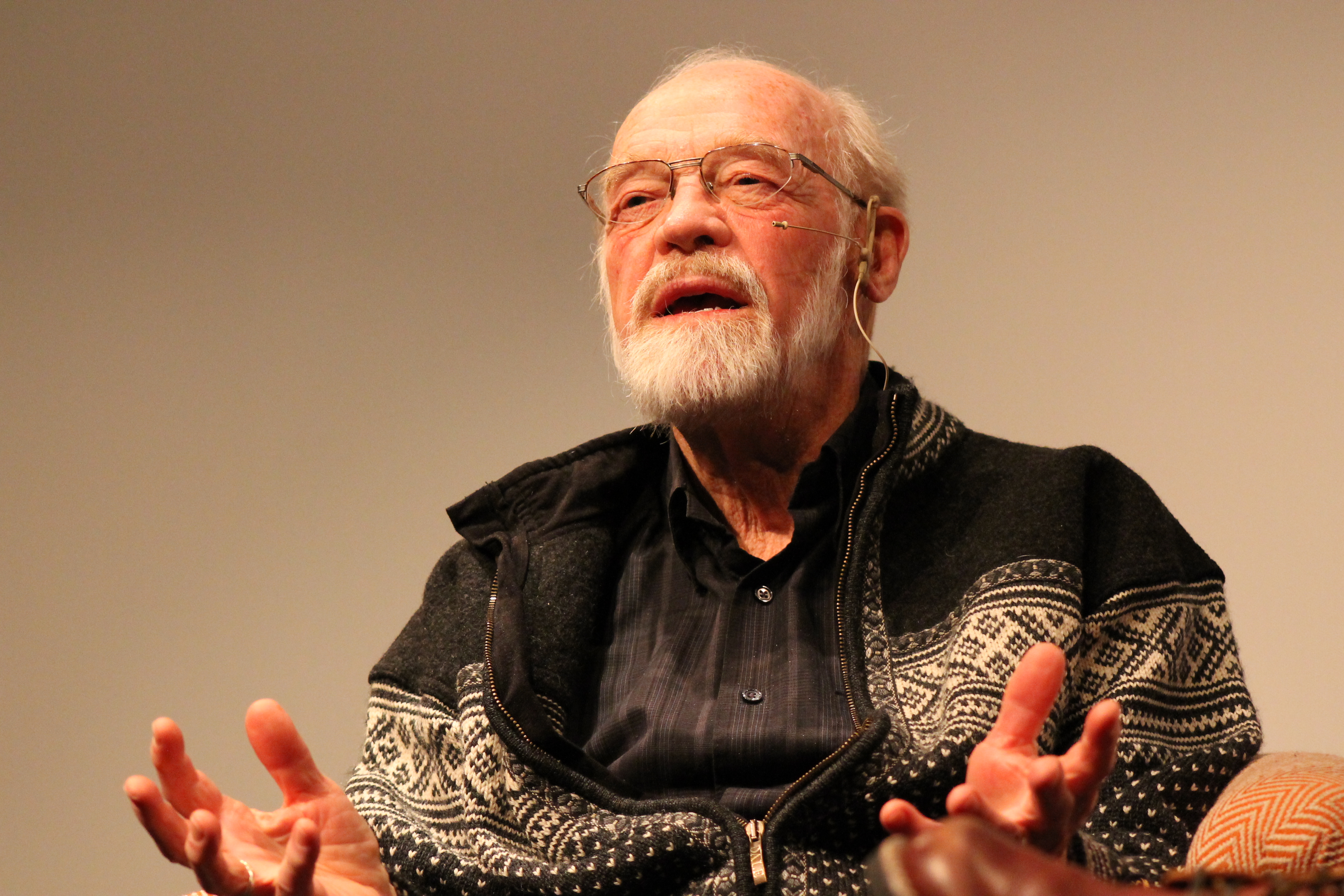
Eugene Peterson
Source:http://is.gd/v70AAI
In Tell It Slant, Eugene Peterson says, “The classic set prayers for Christians and Jews are the Psalms.” For Christians, he adds, this collection of prayers also includes Jesus’ prayers.

Set prayers, as Peterson calls them, are words others have prayed that we can use to guide our own prayers. He says, “It is a common and widespread practice in the Christian community to apprentice ourselves to the prayers that Jesus prayed.” Just like we learn to form our letters and numbers by copying those of others, so we can learn to pray by echoing Jesus’ prayers.
So, if you’d like learn to pray more honestly, more consistently, more powerfully, more like Jesus, begin with his prayers. They include the Lord’s Prayer (Mt 6:9-13/Lk 11:2-4), a prayer of thanksgiving (Mt 11:25-26/Lk 10:21), a prayer at a friend’s tomb (Jn 11:41-42), a few prayers as Jesus contemplates the cross (Jn 12:27-28; Mt 25.36-44/Mk 14:32-39/Lk 22:46), a prayer for his followers (Jn 17), and Jesus’ final words from the cross (Mt 27:46/Mk 15:34; Lk 23:34, 46; Jn 20:30).

Sunday, December 23, 2012

Notes from the Corner - Advent IV - Love for the Shepherds

Gypsy Shepherds
Source: Wikimedia Commons
The shepherds camped with their flocks outside Bethlehem were unloved men. No mother, no bride worried for them during the long nights. Perhaps they had a few shepherd buddies that they might trade stories with or meet at the tavern. But society in general overlooked these men. They were the ancient equivalent of today’s retail clerks or gas bar attendants: not faces or names most would remember.

But then the angel appeared to these men, announcing, “Today a Savior has been born for you” (Luke 2:10-12). The angel said this news would bring “great joy to all the people.” Joy for all the people must include those often forgotten or overlooked, folks like the shepherds.
We believe that Christmas means love, and we show that love when we share meals, cards, and gifts with family and friends. However, the true spirit of Christmas love is to love those whom nobody else loves, people like the shepherds. That’s the kind of love God shows at Christmas.

Snippet from Sunday - Christmas Means Love - December 23

This season is all about love. We could add the love we have for friends, the camaraderie we share with co-workers, the cookies we carry next door to neighbors, the warm handshakes and hugs and cards we give and receive after a church service.

As believers and followers of Jesus, we suspect that this strong holiday feeling of love must in some way spring from the birth of our Savior. But we’re left a bit puzzled when we have to explain exactly what the child born in Bethlehem has to do with young couples holding hands while they skate or pretty packages piled underneath a pine tree. How do we trace the connections down from the virgin mother and the angels and shepherds and wise men all the way to the joy we feel as we bake butter tarts and peppernuts and other Christmas sweets to share with loved ones?

Here’s the truth about love and Christmas: Jesus was born because of love and for love. Jesus was born because God loves us, and Jesus was born for the purpose of bringing God’s love to us. The good news of Christmastime doesn’t get any more simple than that. “God loved us and sent his Son” (Jn 3.16).

Every act of love in this season, and in every season, has the potential to echo or to reflect God’s greatest expression of love toward us. Sometimes our expressions of love mirror God’s love with a joyful holiness; sometimes what we think of love is barely a pale reflection, something in which we can recognize a trace resemblance to God’s love only with a lot of hard work and imagination. . .

What we often call love is a strange alloy. It’s part love--the kind of love God shows--and in large part something else. We mix in lust or fear or self-congratulatory pride. Sure, there are trace amounts of real love there, but mostly it’s our desire for possession or pleasure. There’s a bit of true love there, but it’s overshadowed by our fear of being alone, our fear that the other person will leave us. It’s polluted by how good we feel about ourselves for loving others so extravagantly.

What we need is some refining fire to purify our love. We need some North Star to set the compass of our love by.

(Check out the whole sermon after the jump . . .)

Monday, December 17, 2012

Reflections on a Christmas Pageant - December 16

Kids bring us together. The tragedy in Newtown, Connecticut, leaves us all strongly aware of this. Yesterday our congregation joined with folks around the globe, believers and non-believers alike, in praying for comfort and peace, an end to such violence, for the families in Newtown.

I feel almost a duty to write about the horror of school shootings, the absolute horror of a shooting in an elementary school. This violence, with an altogether new terror and repulsion, tugs at a deep place in my heart. I remember walking my high school hallways in the days after Columbine. I cannot fully tell my own story without recounting how the televised news of that violence changed me.

But these stories and laments were in part displaced yesterday by the implacable church calendar: The Sunday School Christmas pageant was scheduled for yesterday morning. We had given the hour of our worship service to the kids to tell us the good news story of Jesus' birth.

Part of me sees a difficult irony in this. Kids sharing good news in the midst of so much tragic news about children. But hope often sounds difficult and ironic in our ears (no one foregrounds the interplay of hope and irony better than John the Evangelist). 

The kids of our congregation toddled in their homemade shepherd's costumes, some with stuffed lambs clutched in one hand. Mary and Joseph stood silent and wide-eyed before their grandparents and parents in the pews, uttering a barely audible "Oh, okay" when the angel delivered news of Jesus' impending birth. King (or, in our case, Queen) Herod gave directions to magi who were not quite on stage yet. 

In short, their Christmas program had all the dear details, the amateur earnestness, that fill adults' hearts with comfort and joy during this season. When we sang our closing hymn, "Come, Thou Long-Expected Jesus," I was certain those in the pews had heard good news as surely as if the angel Gabriel himself had appeared in our midst. Parents beamed, directors and stagehands laughed with relief, children jumped up and down in excitement as they received their Christmas treat bags from their Sunday School teachers.

I stood back and smiled. The kids had brought good news to us: "A savior is born to bring peace to all people."

But, Oh, that we lived in that peace now. Through Advent we've sang a simple song, "Come, Lord, and Bring Hope." Each verse substitutes a new word for hope: peace, joy, love, life. In some ways, our God has already answered our congregational prayer: Jesus has come, Jesus was born, Jesus lived and loved, healed and taught, Jesus submitted to death, Jesus has even risen once more to life! Like the more traditional Advent carol, "O Come, O Come, Emmanuel," our songs in this season are in no small part a re-enactment, a remembering of longings our God has already filled.

But as I watched the kids' program from the sound booth, I had the dark realization that we do not have more than twenty kids in our Sunday School program. Most of the kids are elementary-aged. Peace is still far from us. So are hope, joy, love, and life.

I gave my closing thoughts to the congregation after the program. Throughout the weeks and even months leading up to Advent, I've felt strong conviction that this worship service was one in which to be forthrightly evangelistic. I prepared my reflection early in the week, before any of us would or could have imagined such tragedy would occur so near to us. (You can read my thoughts posted below, if you'd like.)

I delivered my closing message as I'd prepared it, unsure how to speak on tragedy without robbing the kids of their joyous presentation. But I'm not confident that I made the right decision. Perhaps, I think, I should have spoken more directly to the tragic irony of proclaiming hope and peace in violent times. I'd value your input. 

Let us pray and act for peace.

(You can read the full text of what I said after the jump . . .)

Sunday, December 16, 2012

Notes from the Corner - Advent III - Joy for the Shepherds

The third Advent candle is pink instead of purple. The purple candles that burn on weeks one, two, and four remind us to prepare the way. The candle lit this week, however, reminds us to rejoice!

God’s Son comes to bring life, justice, peace, and plenty to the world. He heals the sick, comforts the sorrowful, provides for the hungry, and forgives the sinful. I can’t think of a better reason for a season of celebration.

Most renditiosn I’ve heard of the angels’ chorus for the shephed sets it to regal music, full of fanfare fit for a king. George Frideric Handel’s magnificent Messiah is one beautiful example. But I wonder if the joy of the angel’s message might be better set to a tune the shepherds might have danced to. “Glory to God in the highest, and peace on earth to people whom God favors” is a lyric that should make our hearts laugh and our toes tap.

Sunday, December 9, 2012

Snippet from Sunday - December 9 - Roadblocks to Peace

Every year I look forward to unwrapping the simple wooden characters from their newspaper and reenacting the Christmas story with them. The angel will stand over an empty manger near the tree. Mary, Joseph, and a donkey will begin their long journey toward Bethlehem, probably on a bookshelf across the room. The shepherds will be watching their sheep on a windowsill, and the wise men will be off in another room, looking for their star. Step by step, all will make their way across the room toward the manger scene where the Christ Child will be born.

One figure whom I never find in nativity scenes is John the Baptist. True enough, John didn’t gather with Mary, Joseph, and the shepherds in that Bethlehem stable. But neither did the three kings, and still they always manage to make an appearance in our miniature re-creations.

Without fail, however, John shows up in our Scripture readings for Advent. All four Gospels--Matthew, Mark, Luke, and John--begin the story of Jesus’ life and ministry by telling us about this baptizing prophet who was sent to prepare the way for Jesus. Luke, who is our guide for this year’s Advent season, doubles the emphasis on John’s importance by telling John’s birth story alongside that of Jesus. We hear almost as much about Elizabeth, Zechariah, and their miracle baby John as we do about Mary, Joseph, and the truly miraculous birth of Jesus. We can’t read and hear all these stories without getting the feeling that there must be something important about John’s ministry of preparation for those of us who follow Jesus.

(Check out the whole sermon after the jump . . .)
Related Posts Plugin for WordPress, Blogger...