Saturday, May 21, 2011

Review :: Revise Us Again :: Frank Viola

This afternoon I joined many others from my church-community to help a friend move to a new apartment. After we had carted the last box, last couch, last bookshelf up two flights of stairs and milled about for some celebratory Little Caesar’s Hot-N-Ready’s to arrive, a teen let out an exclamation of delight and beckoned me over to the bathroom window. 

“Look down, you can see the neighbor’s koi.”
I looked down, and from our birds-eye perspective, we could see a beautiful fish pond and porch the neighbors had constructed behind their three flat. We stood, leaning over the bathtub, elbows on the bathroom window sill, watching their orange and gold and white bodies oscillate slowly in the water.
I’ve seen koi before. I’m usually not a big fan. I think of them like I think of goldfish--carp in a cage, bred to be pretty but vulnerable in the bigger fish-eat-fish ocean. But from this perspective, gazing down from thirty feet up, with the Chicago rain falling out of a hard grey sky, these fish were beautiful. A hint of nature among the bricks and concrete.
I enjoyed parts of Frank Viola’s Revise Us Again: Living from a Renewed Christian Script. I also was annoyed with parts. The book has its up and downs. 
I don’t want to focus on Revise Us Again as a whole. Initially because it feels a bit too scattered to draw out a single guiding thesis (though the theme--or is it a conceit--of revising the scripts we are practiced in in practicing our faith does run constant and true throughout form beginning to end). But more pressingly, I don’t want to give my page by page response to Viola’s book because all my attention is caught by Viola’s Afterword appended to the body of the text.

Monday, May 9, 2011

Review :: The Power of Religion in the Public Sphere :: Judith Butler, Jürgen Habermas, Charles Taylor, & Cornel West, et. al.

Englewood Review of Books just published my review of The Power of Religion in the Public Sphere by Judith Butler, Jürgen Habermas, Charles Taylor, & Cornel West.

I'll post here the first few paragraphs of the review, but to hear my full take on this interesting volume, you'll have to head over to ERB.

When I hear a sermon or a lecture, I often wonder what sort of script the speaker is using. Not just prepared remarks propped on the lectern or stored in the memory. I’m curious about the cultural scripts that shape and guide what she has to say, the tacitly assumed goals, strategies, evaluative criteria of public discourse.
The Power of Religion in the Public Sphere is less scripted than most essays collections in ethics or political philosophy. That’s because The Power of Religion isn’t an essay collection. It’s a conversation, minimally edited by Eduardo Mendieta and Jonathan VanAntwerpen, between Judith Butler, Jürgen Habermas, Charles Taylor, and Cornel West. And conversation occasionally careens outside the parameters of the lecture hall.
The October 22, 2009, event this volume recapitulates sought to carry forward dialogue about religion, secularism, and the way we talk about the common good. Fittingly, the event was less four renowned public intellectuals reading four papers and more three discussions between the participants.
Language, deliberation, and translation are key themes that run throughout the four essays and all three discussions. The public sphere is the realm of public conversation about the common good. But a second, unnamed theme runs alongside this consistent concern with language: a concern with power. . . .
For more, head over to ERB. Check out the rest of the issue for other reviews of some good books.

Friday, April 8, 2011

Drinking Water to Give Water :: water.cc


H20 Project from Living Water International on Vimeo.

Jesus said not to broadcast to fasting, to anoint your head with oil, to keep from your left hand what your right is doing. But I think in this case, Jesus would be okay with letting other people in on what's going on.

Saturday, March 26, 2011

Review :: The Road :: Cormac McCarthy

Last night I felt the last snow of this Chicago winter. This has been a winter for snow--deep snow, wet snow, thunder snow. Today the sun is shining; you couldn't tell that the sky was spitting snow last night.

I was driving home from work when the Blizzard of 2011 hit Chicago. As I drove toward the lake on Howard Street, the snow hit like a wall. Newscasts forewarned catastrophe. Once I'd found parking, I marched toward my apartment head-down to keep the snow out of my eyes. Drifts were already filling the courtyard of my building. My wife and I took shelter in our apartment reading Laura Ingalls Wilder's The Long Winter while the wind shook our windows and the sky flashed lightning.

All told, Chicago received 20.9 inches of snowfall. Chicago Public Schools canceled school for the first time in twelve years, and then did so for a second day while giant snow eaters cleared roads. I spent forty-five minutes digging out my car (which was buried up to the windows), twice.

I had finished Cormac McCarthy's The Road a few weeks earlier. Apocalyptic scenarios were on my mind. And then there I was, in the middle of the biggest snowstorm to hit Chicago since 1967. The city shut down. Maybe this was a glimpse of the end.

But I think not. In fact, I think this is a backward way of thinking. See, the next day, when the sky cleared to let the bitter cold sunlight illumine the shining city, Cindy and I went for a walk. We pulled on snow boots and muffled ourselves in scarves, and we struck out to cut a trail toward (of course) Dunkin Donuts. What I saw were traces of sled tracks, a recent immigrant family from Africa digging out their minivan, a tired buy behind the counter pouring coffee, parents exploring the snowscape with their toddlers. This wasn't the apocalypse. That came later.

Friday, March 18, 2011

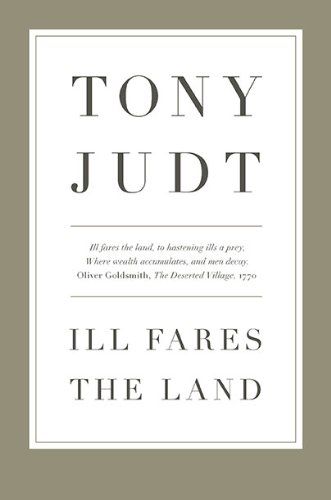
Tell me what you think :: Ill Fares the Land :: Tony Judt

After reviews of Tony Judt's Ill Fares the Land appeared in Commonweal and repeatedly in New York Review Books (here, here-ish, and here), I was curious. Ill Fares the Land reads part political history and part screed. It's the kind of stuff that puts fire in your bones.

That said, I'm new to this game. Recent political history, the rise and fall of social democracy, Keynesian economic theory, and the effects of globalization are all rather new ideas for me.

So I want to know what you think. Or, more precisely, what you read. What books would explicate Judt for me? Blogs? Or, perhaps, what is your opinion of Ill Fares the Land? I'm all ears. . .
Related Posts Plugin for WordPress, Blogger...